重组Anti-CD1d抗体[EPR22526-9] - BSA and Azide free
Anti-CD1d antibody [EPR22526-9] - BSA and Azide free
- RabMAb
- Recombinant
- 了解详情
Be the first to review this product! Submit a review
|
(1 Publication)
Rabbit Recombinant Monoclonal CD1D antibody. Carrier free. Suitable for IP, Flow Cyt, WB and reacts with Human samples. Cited in 1 publication.
查看别名
CD1d, Antigen-presenting glycoprotein CD1d, R3G1, CD1D
- Flow Cyt
Unknown
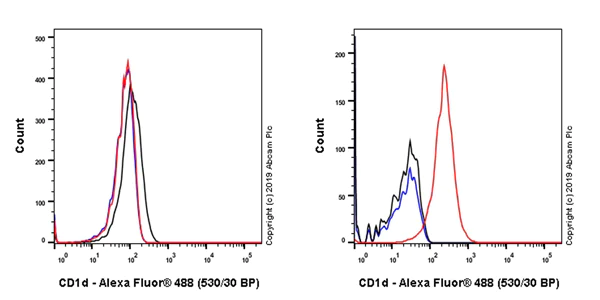
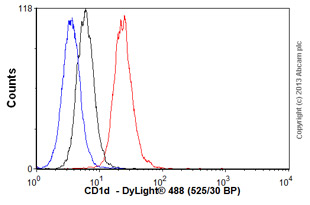
Flow Cytometry - Anti-CD1d antibody [EPR22526-9] - BSA and Azide free (AB256357)
Flow cytometric analysis of K562 (human chronic myelogenous leukemia lymphoblast, Left) / Jurkat (human T cell leukemia T lymphocyte, Right) cells labeling CD1d with ab256344 at 1/600 dilution (0.1μg) (Red) compared with a Rabbit monoclonal IgG (ab172730) (Black) isotype control and an unlabeled control (cells without incubation with primary antibody and secondary antibody) (Blue). Goat anti rabbit IgG (Alexa Fluor® 488, ab150077) at 1/2000 dilution was used as the secondary antibody. Gated on viable cells.
Negative control : K562 (PMID : 21037579).
This data was developed using the same antibody clone in a different buffer formulation containing PBS, BSA, glycerol, and sodium azide (ab256344).
- Flow Cyt
Unknown
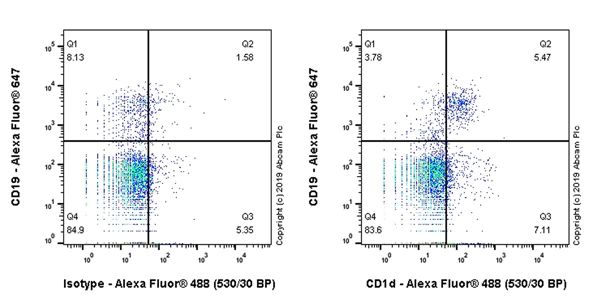
Flow Cytometry - Anti-CD1d antibody [EPR22526-9] - BSA and Azide free (AB256357)
Flow cytometric analysis of human peripheral blood mononuclear cell (PBMC) cells labelling CD1d with ab256344 at 1/600 dilution (0.1μg) (Right) compared with a Rabbit monoclonal IgG (ab172730) (Left) isotype control. Goat anti rabbit IgG (Alexa Fluor® 488, ab150097) at 1/5000 dilution was used as the secondary antibody. Cells were stained with rabbit IgG (Left) or ab256344 (Right). Then stained with anti-CD19 conjugated to Alexa Fluor® 647. Gated on viable cells.
This data was developed using the same antibody clone in a different buffer formulation containing PBS, BSA, glycerol, and sodium azide (ab256344).
- IP
Unknown
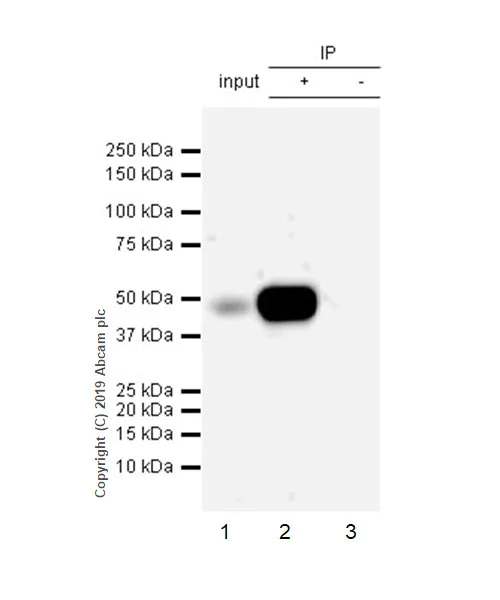
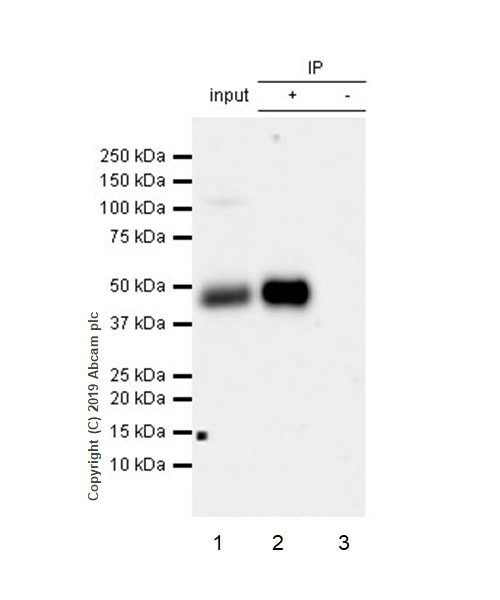
Immunoprecipitation - Anti-CD1d antibody [EPR22526-9] - BSA and Azide free (AB256357)
CD1d was immunoprecipitated from 0.35 mg Jurkat (human T cell leukemia T lymphocyte) whole cell lysate with ab256344 at 1/30 dilution (2μg in 0.35mg lysates). Western blot was performed on the immunoprecipitate using ab256344 at 1/1000 dilution (0.6 μg/ml). VeriBlot for IP Detection Reagent (HRP) (ab131366) was used as the secondary antibody at 1/5000 dilution.
Lane 1 : Jurkat (human T cell leukemia T lymphocyte) whole cell lysate (10μg)
Lane 2 : ab256344 IP in Jurkat whole cell lysate
Lane 3 : Rabbit monoclonal IgG (ab172730) instead of ab256344 in Jurkat whole cell lysate.
Blocking and dilution buffer and concentration : 5% NFDM/TBST.
Exposure time : 3 mins.
This data was developed using the same antibody clone in a different buffer formulation containing PBS, BSA, glycerol, and sodium azide (ab256344).
All lanes:
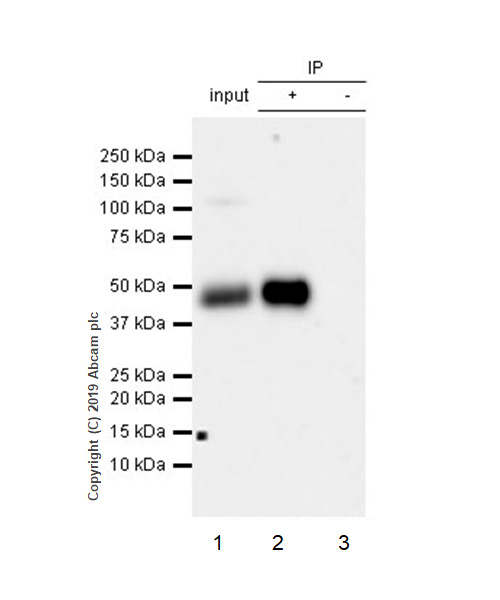
Immunoprecipitation - Anti-CD1d antibody [EPR22526-9] (<a href='/products/primary-antibodies/cd1d-antibody-epr22526-9-ab256344'>ab256344</a>)
Predicted band size: 38 kDa
false
不同偶联物与剂型 (1)
-
Anti-CD1d antibody [EPR22526-9]
替代产品
Primary Antibodies
AB238657
Anti-CD1d antibody [NOR3.2 (NOR3.2/13.17)] - BSA and Azide free
BOND RX™ Validated|Recombinant
- 0
- 0
Primary Antibodies
AB254464
Anti-CD1d antibody [EPR22526-72] - BSA and Azide free
RabMAb|Recombinant
- 0
- 0
搭配使用产品
Primary Antibodies
AB270797
Anti-CD1c antibody [EPR23189-196] - BSA and Azide free
BOND RX™ Validated|RabMAb|Recombinant|KO Validated
- 4
- 4
Primary Antibodies
AB313875
Anti-CD1a antibody [EPR26526-62]
BOND RX™ Validated|20ul selling size|Recombinant|KO Validated|Advanced Validation|RabMAb

- 0
- 0
Primary Antibodies
AB16669
Anti-CD3 epsilon antibody [SP7]
BOND RX™ Validated|RabMAb|Advanced Validation|Recombinant|Lab Essentials|20ul selling size

- 4
- 80
反应性数据
产品详情
ab256357 is the carrier-free version of ab256344.
Patented technology
Our RabMAb® technology is a patented hybridoma-based technology for making rabbit monoclonal antibodies. For details on our patents, please refer to RabMAb® patents.
What are the advantages of a recombinant monoclonal antibody?
This product is a recombinant monoclonal antibody, which offers several advantages including:
- - High batch-to-batch consistency and reproducibility
- - Improved sensitivity and specificity
- - Long-term security of supply
- - Animal-free batch production
For more information, read more on recombinant antibodies.
Conjugation ready
Our carrier-free antibodies are typically supplied in a PBS-only formulation, purified and free of BSA, sodium azide and glycerol. This conjugation-ready format is designed for use with fluorochromes, metal isotopes, oligonucleotides, and enzymes, which makes them ideal for antibody labelling, functional and cell-based assays, flow-based assays (e.g. mass cytometry) and Multiplex Imaging applications.
Use our conjugation kits for antibody conjugates that are ready-to-use in as little as 20 minutes with 1 minute hands-on-time and 100% antibody recovery: available for fluorescent dyes, HRP, biotin and gold.
Compatibility
This product is compatible with the Maxpar® Antibody Labeling Kit from Fluidigm, without the need for antibody preparation. Maxpar® is a trademark of Fluidigm Canada Inc.
性能和储存信息
形式
纯化工艺
存储溶液
运输条件
推荐的短期储存条件
推荐的长期储存条件
储存信息
补充信息
This supplementary information is collated from multiple sources and compiled automatically.
Biological function summary
CD1d functions by presenting lipid and glycolipid antigens to a specialized subset of T cells called invariant Natural Killer T (iNKT) cells. CD1d forms a complex with these antigens in the endosomal compartment before migrating to the cell surface. This interaction is critical for activating iNKT cells which then produce cytokines that influence both innate and adaptive immune responses. It is distinct in its role compared to classical MHC molecules in antigen presentation.
Pathways
CD1d's role in antigen presentation influences numerous immune signaling pathways. Its interaction with iNKT cells is part of the broader immune regulatory network impacting the Th1/Th2 cytokine balance and contributing to immune surveillance. CD1d works alongside proteins involved in these pathways such as CD1b and CD1c which also present lipids to T cells highlighting their involvement in maintaining immune system homeostasis.
产品实验方案
- Visit the General protocols
- Visit the Troubleshooting
靶点信息
文献 (1)
Recent publications for all applications. Explore the full list and refine your search
Methods in molecular biology (Clifton, N.J.) 2664:185-199 PubMed37423991
2023
Applications
Unspecified application
Species
Unspecified reactive species
Abcam Product Promise
Please note: All products are 'FOR RESEARCH USE ONLY. NOT FOR USE IN DIAGNOSTIC OR THERAPEUTIC PROCEDURES'.
For licensing inquiries, please contact partnerships@abcam.com