JavaScript is disabled in your browser. Please enable JavaScript to view this website.
AB17931

Anti-C9 抗体 [53]

Anti-C9 antibody [53]

Be the first to review this product! Submit a review

|

(4 Publications)

Mouse Monoclonal C9 antibody. Suitable for Flow Cyt, ELISA, WB, IHC-P and reacts with Human samples. Cited in 4 publications. Immunogen corresponding to Native Full Length Protein corresponding to Human C9.

查看别名

Complement component C9, C9

2 Images
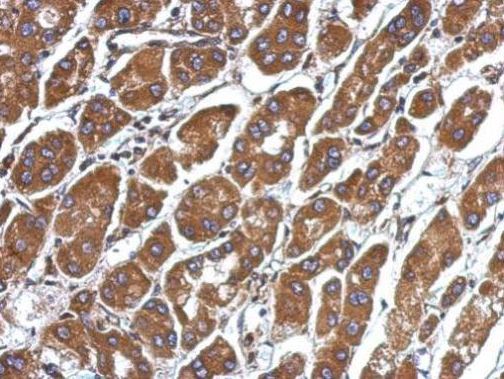
Immunohistochemistry (Formalin/PFA-fixed paraffin-embedded sections) - Anti-C9 antibody [53] (AB17931)
  • IHC-P

Unknown

Immunohistochemistry (Formalin/PFA-fixed paraffin-embedded sections) - Anti-C9 antibody [53] (AB17931)

ab17931 staining human normal liver. Staining is localized to the cytoplasm.
Left panel : with primary antibody at 2 ug/ml. Right panel : isotype control.
Sections were stained using an automated system DAKO Autostainer Plus , at room temperature. Sections were rehydrated and antigen retrieved with the Dako 3-in-1 AR buffer, EDTA pH 9.0 in a DAKO PT Link. Slides were peroxidase blocked in 3% H2O2 in methanol for 10 minutes. They were then blocked with Dako Protein block for 10 minutes (containing casein 0.25% in PBS) then incubated with primary antibody for 20 minutes and detected with Dako Envision Flex amplification kit for 30 minutes. Colorimetric detection was completed with Diaminobenzidine for 5 minutes. Slides were counterstained with Haematoxylin and coverslipped under DePeX. Please note that for manual staining we recommend to optimize the primary antibody concentration and incubation time (overnight incubation), and amplification may be required.

Flow Cytometry - Anti-C9 antibody [53] (AB17931)
  • Flow Cyt

Unknown

Flow Cytometry - Anti-C9 antibody [53] (AB17931)

Overlay histogram showing HeLa cells stained with ab17931 (red line). The cells were fixed with 80% methanol (5 min) and then permeabilized with 0.1% PBS-Tween for 20 min. The cells were then incubated in 1x PBS / 10% normal goat serum / 0.3M glycine to block non-specific protein-protein interactions followed by the antibody (ab17931, 1μg/1x106 cells) for 30 min at 22°C. The secondary antibody used was DyLight® 488 goat anti-mouse IgG (H+L) (ab96879) at 1/500 dilution for 30 min at 22°C. Isotype control antibody (black line) was mouse IgG1 [ICIGG1] (ab91353, 2μg/1x106 cells) used under the same conditions. Acquisition of >5,000 events was performed.

关键信息

宿主种属

Mouse

克隆

Monoclonal

克隆号

53

亚型

IgG1

轻链类型

kappa

不含载体蛋白

No

反应种属

Human

应用

IHC-P, WB, ELISA, Flow Cyt

applications

免疫原

Native Full Length Protein corresponding to Human C9.

P02748

反应性数据

{ "title": "Reactivity Data", "filters": { "stats": ["", "Species", "Dilution Info", "Notes"], "tabs": { "all-applications": {"fullname" : "All Applications", "shortname": "All Applications"}, "FlowCyt" : {"fullname" : "Flow Cytometry", "shortname":"Flow Cyt"}, "ELISA" : {"fullname" : "ELISA", "shortname":"ELISA"}, "WB" : {"fullname" : "Western blot", "shortname":"WB"}, "IHCP" : {"fullname" : "Immunohistochemistry (Formalin/PFA-fixed paraffin-embedded sections)", "shortname":"IHC-P"} }, "product-promise": { "all": "all", "testedAndGuaranteed": "tested", "guaranteed": "expected", "predicted": "predicted", "notRecommended": "not-recommended" } }, "values": { "Human": { "FlowCyt-species-checked": "testedAndGuaranteed", "FlowCyt-species-dilution-info": "1 µg for 10^6 Cells", "FlowCyt-species-notes": "<p><a href='/products/primary-antibodies/mouse-igg1-kappa-monoclonal-15-6e10a7-isotype-control-ab170190'>ab170190</a> - Mouse monoclonal IgG1, is suitable for use as an isotype control with this antibody.</p>", "ELISA-species-checked": "guaranteed", "ELISA-species-dilution-info": "", "ELISA-species-notes": "<p></p>", "WB-species-checked": "guaranteed", "WB-species-dilution-info": "", "WB-species-notes": "<p></p>", "IHCP-species-checked": "testedAndGuaranteed", "IHCP-species-dilution-info": "2 µg/mL", "IHCP-species-notes": "<p></p>" } } }

产品详情

ab17931 recognizes C9 in human serum diluted 1:50 in Tris buffer (20 mM Tris-base, 1 mM MgCl2, 1 mM CaCl2 and 140 mM NaCl) and incubated for 2 hours at 37°C using a human IgM coated (10 μg/mL overnight at 4°C, blocked with PBS 7.2 + 1% BSA for 1 hour).

性能和储存信息

形式
Liquid
纯化工艺
Affinity purification Protein G
纯化说明
Protein A/G purified.
存储溶液
pH: 7.4 Preservative: 0.097% Sodium azide Constituents: PBS, 0.754% Sodium chloride
运输条件
Blue Ice
推荐的短期储存时间
1-2 weeks
推荐的短期储存条件
+4°C
推荐的长期储存条件
-20°C
储存信息
Avoid freeze / thaw cycle

补充信息

This supplementary information is collated from multiple sources and compiled automatically.

C9 also known as complement component 9 is a protein that plays an essential mechanical role in the complement system. It typically associates in the formation of the membrane attack complex (MAC). The C9 protein weighing around 71 kDa expresses in the liver and is secreted into the blood plasma. Alternative names like 'Cloud 9 capture' and 'C9 tag' often refer to research tools or motifs derived from the C9 protein rather than the protein itself. Researchers frequently study C9 in mouse models where its physiological roles can be explored.
Biological function summary

C9 participates in defending against pathogens. It joins other complement components like C5b C6 C7 and C8 to form the MAC complex which facilitates cell lysis by forming pores in the membrane of target cells. This action directly results in microbial cell destruction serving a critical immune function. C9 is not only part of the MAC complex but also holds significance due to its unique function as the last step in the formation of the pore influencing the efficacy of pathogen elimination.

Pathways

C9 functions primarily within the complement cascade which includes the classical and alternative pathways. Its role is in the terminal pathway segment that ultimately leads to the formation of the MAC and follows the activation of C5 which cleaves to produce C5b. This connection extends to proteins like C3 which is upstream in the cascade and significantly impacts the cascade's activation highlighting C9's function as an integral terminal component in these pathways.

Mutations or deficits in C9 relate to an increased susceptibility to infections particularly those caused by Neisseria species. This association results directly from its important role in the MAC formation. Additionally deficiency of C9 links to autoimmune disorders where the immune response may be improperly regulated due to compromised MAC formation. Other complement components like C6 and C8 may also relate to these diseases due to their collaboration with C9 in forming the MAC illustrating the interconnectedness of these proteins within the immune response framework.

产品实验方案

For this product, it's our understanding that no specific protocols are required. You can visit:

靶点信息

Pore-forming component of the membrane attack complex (MAC), a multiprotein complex activated by the complement cascade, which inserts into a target cell membrane and forms a pore, leading to target cell membrane rupture and cell lysis (PubMed : 22832194, PubMed : 26841837, PubMed : 26841934, PubMed : 27052168, PubMed : 30552328, PubMed : 6177822, PubMed : 9212048, PubMed : 9634479). The MAC is initiated by proteolytic cleavage of C5 into complement C5b in response to the classical, alternative, lectin and GZMK complement pathways (PubMed : 39914456, PubMed : 39814882, PubMed : 9212048, PubMed : 9634479). The complement pathways consist in a cascade of proteins that leads to phagocytosis and breakdown of pathogens and signaling that strengthens the adaptive immune system (PubMed : 9212048, PubMed : 9634479). Constitutes the pore-forming subunit of the MAC complex : during MAC assembly, C9 associates with the C5b8 intermediate complex, and polymerizes to complete the pore (PubMed : 26841934, PubMed : 30111885, PubMed : 30552328, PubMed : 34752492, PubMed : 4055801, PubMed : 6177822).
See full target information C9

文献 (4)

Recent publications for all applications. Explore the full list and refine your search

Cancers 13: PubMed34201241

2021

Development of EndoScreen Chip, a Microfluidic Pre-Endoscopy Triage Test for Esophageal Adenocarcinoma.

Applications

Unspecified application

Species

Unspecified reactive species

Julie A Webster,Alain Wuethrich,Karthik B Shanmugasundaram,Renee S Richards,Wioleta M Zelek,Alok K Shah,Louisa G Gordon,Bradley J Kendall,Gunter Hartel,B Paul Morgan,Matt Trau,Michelle M Hill

Journal of cellular and molecular medicine 23:7449-7461 PubMed31512366

2019

Silencing of NONO inhibits abdominal aortic aneurysm in apolipoprotein E-knockout mice via collagen deposition and inflammatory inhibition.

Applications

Unspecified application

Species

Unspecified reactive species

Xingli Xu,Fang Zhang,Yue Lu,Sufang Yu,Wenqian Sun,Shangwen Sun,Jing Cheng,Jing Ma,Meng Zhang,Cheng Zhang,Yun Zhang,Kai Zhang

American journal of nephrology 41:48-56 PubMed25662584

2015

Renal C3 complement component: feed forward to diabetic kidney disease.

Applications

Unspecified application

Species

Unspecified reactive species

Katherine J Kelly,Yunlong Liu,Jizhong Zhang,Jesus H Dominguez

Proteomics 10:3210-21 PubMed20707004

2010

Upregulation of plasma C9 protein in gastric cancer patients.

Applications

IHC-P, WB

Species

Human, Human

Poh-Kuan Chong,Huiyin Lee,Marie Chiew Shia Loh,Lee-Yee Choong,Qingsong Lin,Jimmy Bok Yan So,Khong Hee Lim,Ross Andrew Soo,Wei Peng Yong,Siew Pang Chan,Duane T Smoot,Hassan Ashktorab,Khay Guan Yeoh,Yoon Pin Lim
View all publications

Abcam Product Promise

我们致力于为您的研究提供高质量的试剂,为您科研的每一步提供支持。若我们的产品未能达到预期性能,我们向您提供 Abcam Product Promise 保障。
详情请参阅我们的条款与条件。

Please note: All products are 'FOR RESEARCH USE ONLY. NOT FOR USE IN DIAGNOSTIC OR THERAPEUTIC PROCEDURES'.

For licensing inquiries, please contact partnerships@abcam.com