JavaScript is disabled in your browser. Please enable JavaScript to view this website.
AB201471

重组生物素Anti-eIF4E (phospho S209)抗体[EP2151Y]

Biotin Anti-eIF4E (phospho S209) antibody [EP2151Y]

Be the first to review this product! Submit a review

|

(1 Publication)

Rabbit Recombinant Monoclonal eIF4E phospho S209 antibody - conjugated to Biotin. Suitable for IHC-P, WB and reacts with Human, Mouse, Rat samples. Cited in 1 publication.

查看别名

EIF4EL1, EIF4F, EIF4E, Eukaryotic translation initiation factor 4E, eIF-4E, eIF4E, eIF-4F 25 kDa subunit, mRNA cap-binding protein
1 Images
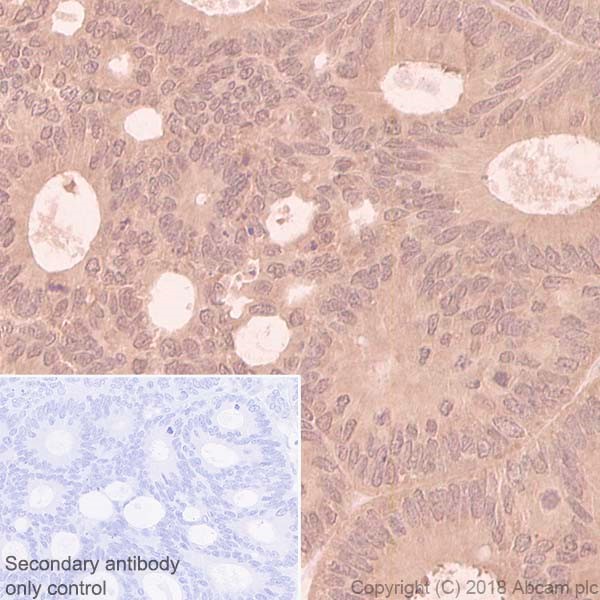
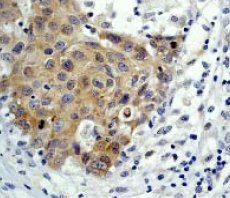
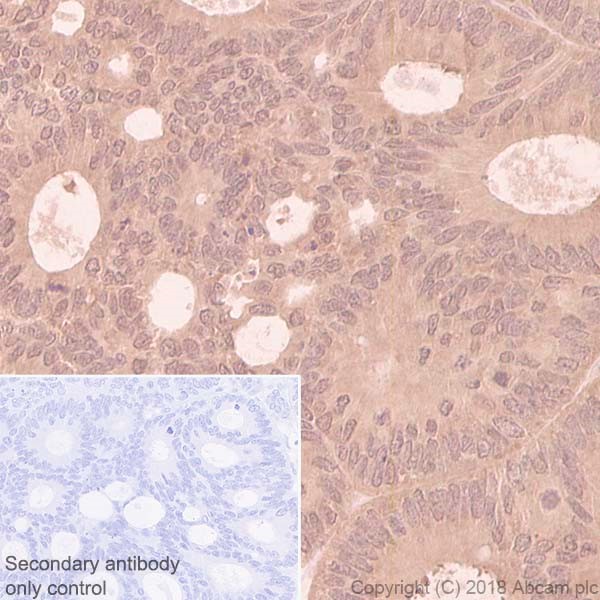
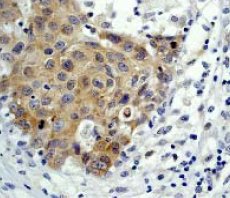
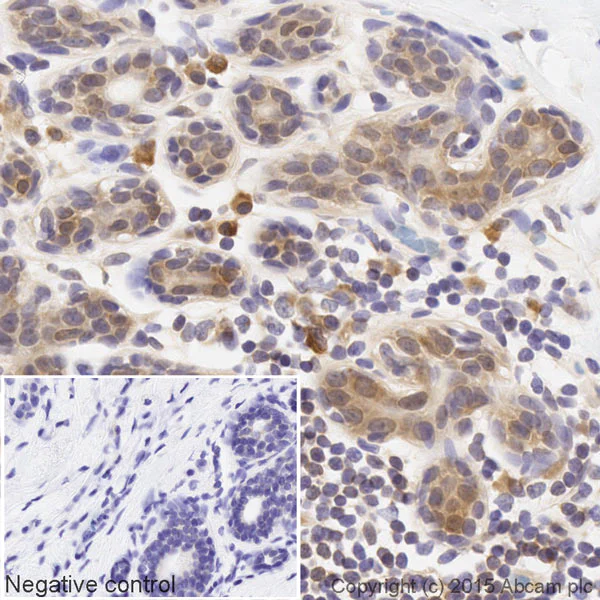
Immunohistochemistry (Formalin/PFA-fixed paraffin-embedded sections) - Biotin Anti-eIF4E (phospho S209) antibody [EP2151Y] (AB201471)
  • IHC-P

Lab

Immunohistochemistry (Formalin/PFA-fixed paraffin-embedded sections) - Biotin Anti-eIF4E (phospho S209) antibody [EP2151Y] (AB201471)

IHC image of eIF4E (phospho S209) staining in a section of formalin-fixed paraffin-embedded human breast cancer (adenocarcinoma)*, performed on a Leica Bond system using the standard protocol B. The section was pre-treated using heat mediated antigen retrieval with sodium citrate buffer (pH6, epitope retrieval solution 1) for 20 mins. The section was then incubated with ab201471 at 1/50 dilution, for 15 mins at room temperature and detected using an HRP conjugated ABC system. DAB was used as the chromogen. The section was then counterstained with haematoxylin and mounted with DPX.

The inset negative control image is taken from an identical assay without primary antibody.

For other IHC staining systems (automated and non-automated) customers should optimize variable parameters such as antigen retrieval conditions, primary antibody concentration and antibody incubation times.

*Tissue obtained from the Human Research Tissue Bank, supported by the NIHR Cambridge Biomedical Research Centre.

不同偶联物与剂型 (3)

  • Unconjugated

    Anti-eIF4E (phospho S209) antibody [EP2151Y]

  • Carrier free

    Anti-eIF4E (phospho S209) antibody [EP2151Y] - BSA and Azide free (Detector)

  • Carrier free

    Anti-eIF4E (phospho S209) antibody [EP2151Y] - BSA and Azide free

关键信息

宿主种属

Rabbit

克隆

Monoclonal

克隆号

EP2151Y

亚型

IgG

偶联物

Biotin

激发波长/发射波长
不含载体蛋白

No

反应种属

Human, Mouse, Rat

应用

IHC-P, WB

applications

免疫原

The exact immunogen used to generate this antibody is proprietary information.

反应性数据

{ "title": "Reactivity Data", "filters": { "stats": ["", "Species", "Dilution Info", "Notes"], "tabs": { "all-applications": {"fullname" : "All Applications", "shortname": "All Applications"}, "IHCP" : {"fullname" : "Immunohistochemistry (Formalin/PFA-fixed paraffin-embedded sections)", "shortname":"IHC-P"}, "WB" : {"fullname" : "Western blot", "shortname":"WB"} }, "product-promise": { "all": "all", "testedAndGuaranteed": "tested", "guaranteed": "expected", "predicted": "predicted", "notRecommended": "not-recommended" } }, "values": { "Human": { "IHCP-species-checked": "testedAndGuaranteed", "IHCP-species-dilution-info": "1/50 - 1/100", "IHCP-species-notes": "<p></p>", "WB-species-checked": "guaranteed", "WB-species-dilution-info": "", "WB-species-notes": "<p></p>" }, "Mouse": { "IHCP-species-checked": "guaranteed", "IHCP-species-dilution-info": "", "IHCP-species-notes": "<p></p>", "WB-species-checked": "guaranteed", "WB-species-dilution-info": "", "WB-species-notes": "<p></p>" }, "Rat": { "IHCP-species-checked": "guaranteed", "IHCP-species-dilution-info": "", "IHCP-species-notes": "<p></p>", "WB-species-checked": "guaranteed", "WB-species-dilution-info": "", "WB-species-notes": "<p></p>" }, "Pig": { "IHCP-species-checked": "predicted", "IHCP-species-dilution-info": "", "IHCP-species-notes": "", "WB-species-checked": "predicted", "WB-species-dilution-info": "", "WB-species-notes": "" } } }

产品详情

Patented technology
Our RabMAb® technology is a patented hybridoma-based technology for making rabbit monoclonal antibodies. For details on our patents, please refer to RabMAb® patents.

性能和储存信息

形式
Liquid
纯化工艺
Affinity purification Protein A
存储溶液
pH: 7.4 Preservative: 0.02% Sodium azide Constituents: PBS, 30% Glycerol (glycerin, glycerine), 1% BSA
运输条件
Blue Ice
推荐的短期储存时间
1-2 weeks
推荐的短期储存条件
+4°C
推荐的长期储存条件
-20°C
分装信息
Upon delivery aliquot
储存信息
Stable for 12 months at -20°C|Store in the dark

补充信息

This supplementary information is collated from multiple sources and compiled automatically.

The eIF4E protein also known as the eukaryotic translation initiation factor 4E functions mainly in the initiation phase of mRNA translation. It plays a role by binding to the 7-methylguanylate cap structure at the 5’ end of mRNA facilitating ribosome assembly on mRNA. The molecular weight of eIF4E is approximately 25 kDa and it is ubiquitously expressed in various tissues across eukaryotic organisms. Additionally phosphorylation of eIF4E affects its activity and is an important post-translational modification.
Biological function summary

EIF4E regulates gene expression at the translational level and is a part of the eIF4F complex which also includes eIF4A and eIF4G. This complex is essential for the recruitment of ribosomes to the mRNA impacting the rate of protein synthesis. Changes in eIF4E levels can alter the translational efficiency of specific mRNAs thereby influencing cellular growth and proliferation.

Pathways

EIF4E directly involves in the mTOR signaling pathway which regulates cell growth proliferation and survival. Within this pathway eIF4E interacts with proteins such as 4EBP1 which binds to eIF4E and inhibits its function in the absence of phosphorylation by mTOR. This interaction illustrates the control mechanism of protein synthesis under different cellular conditions connecting it to various signaling cascades.

EIF4E has been linked to cancer and neurodegenerative conditions. In cancer overexpression of eIF4E leads to increased translation of oncogenes facilitating tumorigenesis. The mTOR pathway proteins like mTOR and 4EBP1 are often dysregulated in these cases. Conversely its role in neurological disorders involves the aberrant regulation of synaptic proteins like PSD95 impacting neuronal communication and function.

产品实验方案

For this product, it's our understanding that no specific protocols are required. You can visit:

靶点信息

Acts in the cytoplasm to initiate and regulate protein synthesis and is required in the nucleus for export of a subset of mRNAs from the nucleus to the cytoplasm which promotes processes such as RNA capping, processing and splicing (PubMed : 11606200, PubMed : 22578813, PubMed : 22684010, PubMed : 24335285, PubMed : 29987188). Component of the protein complex eIF4F, which is involved in the recognition of the mRNA cap, ATP-dependent unwinding of 5'-terminal secondary structure and recruitment of mRNA to the ribosome (By similarity). This protein recognizes and binds the 7-methylguanosine (m7G)-containing mRNA cap during an early step in the initiation of protein synthesis and facilitates ribosome binding by inducing the unwinding of the mRNAs secondary structures (PubMed : 16271312, PubMed : 22578813). Together with EIF4G1, antagonizes the scanning promoted by EIF1-EIF4G1 and is required for TISU translation, a process where the TISU element recognition makes scanning unnecessary (PubMed : 29987188). In addition to its role in translation initiation, also acts as a regulator of translation and stability in the cytoplasm (PubMed : 24335285). Component of the CYFIP1-EIF4E-FMR1 complex which binds to the mRNA cap and mediates translational repression : in the complex, EIF4E mediates the binding to the mRNA cap (By similarity). Component of a multiprotein complex that sequesters and represses translation of proneurogenic factors during neurogenesis (By similarity). In P-bodies, component of a complex that mediates the storage of translationally inactive mRNAs in the cytoplasm and prevents their degradation (PubMed : 24335285). May play an important role in spermatogenesis through translational regulation of stage-specific mRNAs during germ cell development (By similarity). As well as its roles in translation, also involved in mRNA nucleocytoplasmic transport (By similarity). Its role in mRNA export from the nucleus to the cytoplasm relies on its ability to bind the m7G cap of RNAs and on the presence of the 50-nucleotide EIF4E sensitivity element (4ESE) in the 3'UTR of sensitive transcripts (By similarity). Interaction with the 4ESE is mediated by LRPPRC which binds simultaneously to both EIF4E and the 4ESE, thereby acting as a platform for assembly for the RNA export complex (By similarity). EIF4E-dependent mRNA export is independent of ongoing protein or RNA synthesis and is also NFX1-independent but is XPO1-dependent with LRPPRC interacting with XPO1 to form an EIF4E-dependent mRNA export complex (By similarity). Alters the composition of the cytoplasmic face of the nuclear pore to promote RNA export by reducing RANBP2 expression, relocalizing nucleoporin NUP214 and increasing expression of RANBP1 and RNA export factors DDX19 and GLE1 (By similarity). Promotes the nuclear export of cyclin CCND1 mRNA (By similarity). Promotes the nuclear export of NOS2/iNOS mRNA (PubMed : 23471078). Promotes the nuclear export of MDM2 mRNA (PubMed : 22684010). Promotes the export of additional mRNAs, including others involved in the cell cycle (By similarity). In the nucleus, binds to capped splice factor-encoding mRNAs and stimulates their nuclear export to enhance splice factor production by increasing their cytoplasmic availability to the translation machinery (By similarity). May also regulate splicing through interaction with the spliceosome in an RNA and m7G cap-dependent manner (By similarity). Also binds to some pre-mRNAs and may play a role in their recruitment to the spliceosome (By similarity). Promotes steady-state capping of a subset of coding and non-coding RNAs by mediating nuclear export of capping machinery mRNAs including RNMT, RNGTT and RAMAC to enhance their translation (By similarity). Stimulates mRNA 3'-end processing by promoting the expression of several core cleavage complex factors required for mRNA cleavage and polyadenylation, and may also have a direct effect through its interaction with the CPSF3 cleavage enzyme (By similarity). Rescues cells from apoptosis by promoting activation of serine/threonine-protein kinase AKT1 through mRNA export of NBS1 which potentiates AKT1 phosphorylation and also through mRNA export of AKT1 effectors, allowing for increased production of these proteins (By similarity).
See full target information EIF4E pS209

文献 (1)

Recent publications for all applications. Explore the full list and refine your search

Translational research : the journal of laboratory and clinical medicine 247:1-18 PubMed35405322

2022

Cytokine profiling in pulmonary arterial hypertension: the role of redox homeostasis and sex.

Applications

Unspecified application

Species

Unspecified reactive species

Ruslan Rafikov,Franz Rischard,Mikhail Vasilyev,Mathews V Varghese,Jason X-J Yuan,Ankit A Desai,Joe G N Garcia,Olga Rafikova
View all publications

Abcam Product Promise

我们致力于为您的研究提供高质量的试剂,为您科研的每一步提供支持。若我们的产品未能达到预期性能,我们向您提供 Abcam Product Promise 保障。
详情请参阅我们的条款与条件。

Please note: All products are 'FOR RESEARCH USE ONLY. NOT FOR USE IN DIAGNOSTIC OR THERAPEUTIC PROCEDURES'.

For licensing inquiries, please contact partnerships@abcam.com