JavaScript is disabled in your browser. Please enable JavaScript to view this website.
AB32099

Anti-beta Arrestin 1 抗体 [E274]

Anti-beta Arrestin 1 antibody [E274]

  • KO Validated
  • RabMAb
  • Recombinant
  • 20ul selling size
  • 了解详情

4

(5 Reviews)

|

(53 Publications)

Rabbit Recombinant Monoclonal beta Arrestin 1 antibody. Suitable for WB, ICC/IF, Flow Cyt (Intra) and reacts with Mouse, Human samples. Cited in 53 publications.

查看别名

ARR1, ARRB1, Beta-arrestin-1, Arrestin beta-1, Non-visual arrestin-2
8 Images
Flow Cytometry (Intracellular) - Anti-beta Arrestin 1 antibody [E274] (AB32099)
  • Flow Cyt (Intra)

Unknown

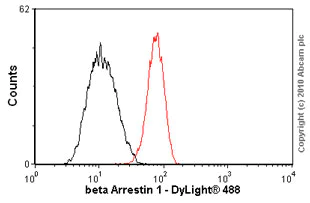
Flow Cytometry (Intracellular) - Anti-beta Arrestin 1 antibody [E274] (AB32099)

Overlay histogram showing PC3 cells stained with unpurified ab32099 (red line). The cells were fixed with methanol (5 min) and then permeabilized with 0.1% PBS-Tween for 20 min. The cells were then incubated in 1x PBS / 10% normal goat serum / 0.3M glycine to block non-specific protein-protein interactions followed by the antibody (unpurified ab32099, 1/10 dilution) for 30 min at 22°C. The secondary antibody used was DyLight® 488 goat anti-rabbit IgG (H+L) (ab96899) at 1/500 dilution for 30 min at 22°C. Isotype control antibody (black line) was rabbit monoclonal IgG (1μg/1x106 cells) used under the same conditions. Acquisition of >5,000 events was performed. This antibody gave a decreased signal in PC3 cells fixed with 4% paraformaldehyde (10 min)/permeabilized in 0.1% PBS-Tween used under the same conditions.

Immunocytochemistry/ Immunofluorescence - Anti-beta Arrestin 1 antibody [E274] (AB32099)
  • ICC/IF

Unknown

Immunocytochemistry/ Immunofluorescence - Anti-beta Arrestin 1 antibody [E274] (AB32099)

Immunocytochemistry/Immunofluorescence analysis of PC-3 cells labelling beta Arrestin 1 with purified ab32099 at a dilution of 1/150. Cells were fixed with 4% paraformaldehyde and permeabilized with 0.1% Triton X-100. ab150077, an Alexa Fluor® 488-conjugated goat anti-rabbit IgG (1/1000) was used as the secondary antibody. DAPI (blue) was used as the nuclear counterstain. ab7291, a mouse anti-tubulin (1/1000) and ab150120, an Alexa Fluor® 594-conjugated goat anti-mouse IgG (1/1000) were also used.

Control 1 : primary antibody (1/150) and secondary antibody, ab150120, an Alexa Fluor® 594-conjugated goat anti-mouse IgG (1/1000).

Control 2 : ab7291 (1/1000) and secondary antibody, ab150077, an Alexa Fluor® 488-conjugated goat anti-rabbit IgG (1/1000).
Immunocytochemistry/ Immunofluorescence - Anti-beta Arrestin 1 antibody [E274] (AB32099)
  • ICC/IF

AbReview30512****

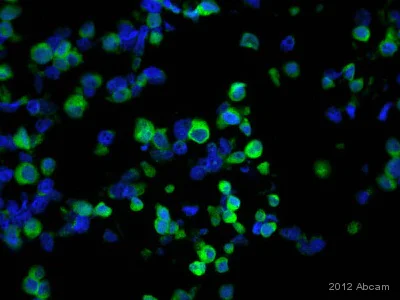
Immunocytochemistry/ Immunofluorescence - Anti-beta Arrestin 1 antibody [E274] (AB32099)

Unpurified ab32099 staining beta Arrestin 1 in C4-2B (Human prostate cancer cell line) by ICC/IF (Immunocytochemistry/immunofluorescence).
Cells were fixed with paraformaldehyde and blocked with 1% serum for 1 hour at 21°C. Samples were incubated with primary antibody (1/100 in diluent) for 1 hour at 21°C. An Alexa Fluor® 488-conjugated goat anti-rabbit polyclonal IgG (1/200) was used as the secondary antibody.

This image is courtesy of an anonymous Abreview.
Western blot - Anti-beta Arrestin 1 antibody [E274] (AB32099)
  • WB

Lab

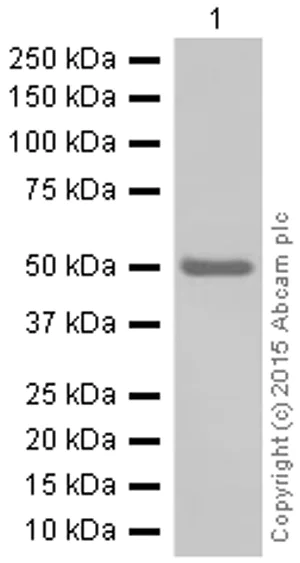
Western blot - Anti-beta Arrestin 1 antibody [E274] (AB32099)

Blocking and dilution buffer : 5% NFDM/TBST

All lanes:

Western blot - Anti-beta Arrestin 1 antibody [E274] (ab32099) at 1/1000 dilution

All lanes:

Jurkat whole cell lysate at 20 µg

Secondary

All lanes:

Western blot - Goat Anti-Rabbit IgG H&L (HRP) (<a href='/products/secondary-antibodies/goat-rabbit-igg-h-l-hrp-ab97051'>ab97051</a>) at 1/20000 dilution

Predicted band size: 47 kDa

Observed band size: 50 kDa

false
Western blot - Anti-beta Arrestin 1 antibody [E274] (AB32099)
  • WB

Lab

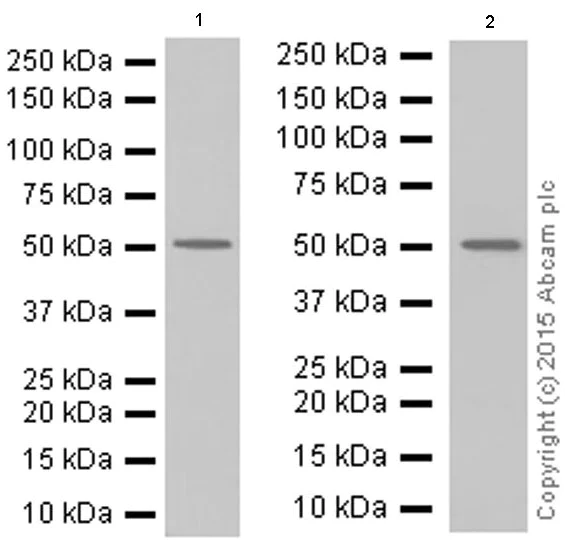
Western blot - Anti-beta Arrestin 1 antibody [E274] (AB32099)

Blocking and dilution buffer : 5% NFDM/TBST

All lanes:

Western blot - Anti-beta Arrestin 1 antibody [E274] (ab32099) at 1/2000 dilution

Lane 1:

HEK293 whole cell lysate at 10 µg

Lane 2:

SH-SY5Y whole cell lysate at 10 µg

Secondary

All lanes:

Western blot - Goat Anti-Rabbit IgG H&L (HRP) (<a href='/products/secondary-antibodies/goat-rabbit-igg-h-l-hrp-ab97051'>ab97051</a>) at 1/20000 dilution

Predicted band size: 47 kDa

Observed band size: 50 kDa

false
Western blot - Anti-beta Arrestin 1 antibody [E274] (AB32099)
  • WB

Lab

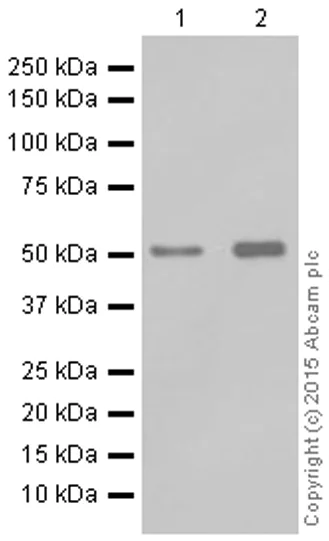
Western blot - Anti-beta Arrestin 1 antibody [E274] (AB32099)

Blocking and dilution buffer : 5% NFDM/TBST

All lanes:

Western blot - Anti-beta Arrestin 1 antibody [E274] (ab32099) at 1/1000 dilution

Lane 1:

C2C12 whole cell lysate at 20 µg

Lane 2:

PC-12 whole cell lysate at 20 µg

Secondary

All lanes:

Western blot - Goat Anti-Rabbit IgG H&L (HRP) (<a href='/products/secondary-antibodies/goat-rabbit-igg-h-l-hrp-ab97051'>ab97051</a>) at 1/20000 dilution

Predicted band size: 47 kDa

Observed band size: 50 kDa

false
Western blot - Anti-beta Arrestin 1 antibody [E274] (AB32099)
  • WB

Lab

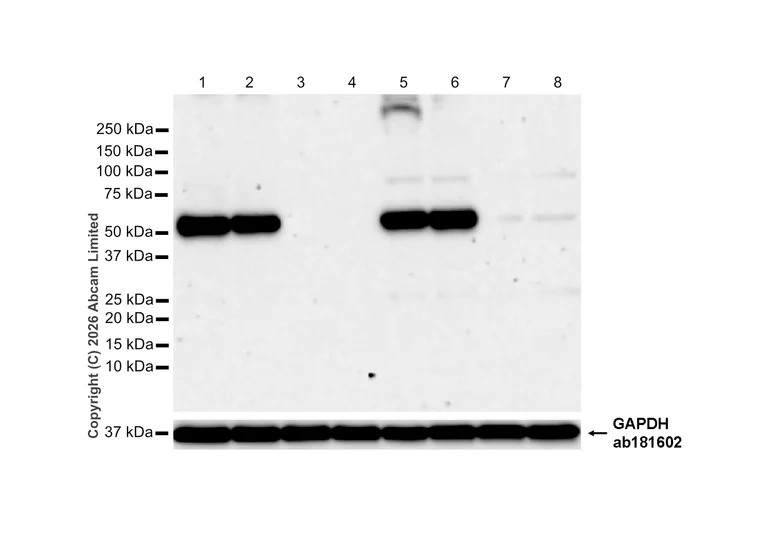
Western blot - Anti-beta Arrestin 1 antibody [E274] (AB32099)

Blocking and diluting buffer and concentration : 5% NFDM/TBST.

The tissue samples were kindly provided by GemPharmatech. C57BL/6JGpt wildtype mice and Arrb1-KO homozygous mice (Strain ID : T014150).

In Western blot, Anti-GAPDH antibody [EPR16891] - Loading Control (ab181602) (1 : 200000) (36KDa).

All lanes:

Western blot - Anti-beta Arrestin 1 antibody [E274] (ab32099) at 1/1000 dilution

Lane 1:

Wild-type mouse cerebral cortex tissue lysate (male case1) at 20 µg

Lane 2:

Wild-type mouse cerebral cortex tissue lysate (male case2) at 20 µg

Lane 3:

Arrb1 knockout mouse cerebral cortex tissue lysate (male case1) at 20 µg

Lane 4:

Arrb1 knockout mouse cerebral cortex tissue lysate (male case2) at 20 µg

Lane 5:

Wild-type mouse lymph node tissue lysate (male case1) at 20 µg

Lane 6:

Wild-type mouse lymph node tissue lysate (male case2) at 20 µg

Lane 7:

Arrb1 knockout mouse lymph node tissue lysate (male case1) at 20 µg

Lane 8:

Arrb1 knockout mouse lymph node tissue lysate (male case2) at 20 µg

Secondary

All lanes:

Western blot - Goat Anti-Rabbit IgG H&L (HRP) (<a href='/products/secondary-antibodies/goat-rabbit-igg-h-l-hrp-ab97051'>ab97051</a>) at 1/20000 dilution

Observed band size: 50 kDa,36 kDa

false

Exposure time: 180s
Western blot - Anti-beta Arrestin 1 antibody [E274] (AB32099)
  • WB

CiteAb

Western blot - Anti-beta Arrestin 1 antibody [E274] (AB32099)

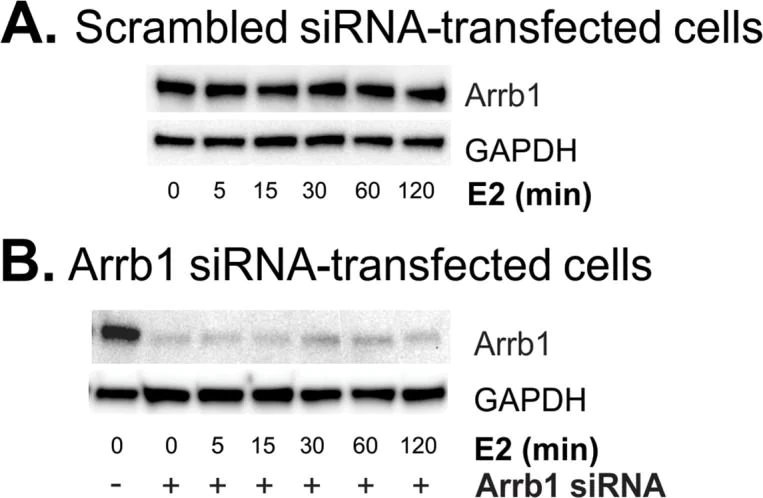
beta Arrestin 1 western blot using anti-beta Arrestin 1 antibody [E274] ab32099. Publication image and figure legend from Wong, A. M., Abrams, M. C., et al., 2015, PLoS One, PubMed 25803606.

ab32099 was used in this publication in western blot. This may not be the same as the application(s) guaranteed by Abcam. For a full list of applications guaranteed by Abcam for ab32099 please see the product overview.

Estradiol (E2)-induced ERK1/2 phosphorylation in N-38 cells was attenuated in cells transfected with Arrb1 siRNA.(A) Western blots from scrambled siRNA-transfected N-38 cells probed with Arrb1 and GAPDH. (B) Arrb1 western blots from scrambled siRNA-transfected N-38 cells showing knockdown of Arrb1 protein. (C) Representative western blots of levels of ERK1/2 (p44/42 MAPK) phosphorylation in scrambled siRNA-transfected N-38 cells and (D) N-38 cells transfected with Arrb1 siRNA treated with estradiol (E2) for 0–120 min. (E) Densitometric analysis of the optical density from western blots of phosphorylated ERK1/2 (p44/42) protein bands normalized to the optical densities of total ERK1/2 protein in scrambled vs. Arrb1 siRNA-transfected cells. Controls for each group (cells not treated with E2) was set at 100%, and E2 treatments were expressed as a percentage of the control. Values represent means (n = 5) ± SEM. * (p<0.05). **(p<0.005).

false

不同偶联物与剂型 (10)

  • Carrier free

    Anti-beta Arrestin 1 antibody [E274] - BSA and Azide free

  • 660 APC

    APC Anti-beta Arrestin 1 antibody [E274]

  • 519 Alexa Fluor® 488

    Alexa Fluor® 488 Anti-beta Arrestin 1 antibody [E274]

  • 565 Alexa Fluor® 555

    Alexa Fluor® 555 Anti-beta Arrestin 1 antibody [E274]

  • 603 Alexa Fluor® 568

    Alexa Fluor® 568 Anti-beta Arrestin 1 antibody [E274]

  • 617 Alexa Fluor® 594

    Alexa Fluor® 594 Anti-beta Arrestin 1 antibody [E274]

  • 665 Alexa Fluor® 647

    Alexa Fluor® 647 Anti-beta Arrestin 1 antibody [E274]

  • 775 Alexa Fluor® 750

    Alexa Fluor® 750 Anti-beta Arrestin 1 antibody [E274]

  • HRP

    HRP Anti-beta Arrestin 1 antibody [E274]

  • 578 PE

    PE Anti-beta Arrestin 1 antibody [E274]

关键信息

宿主种属

Rabbit

克隆

Monoclonal

克隆号

E274

亚型

IgG

不含载体蛋白

No

反应种属

Mouse, Human

应用

Flow Cyt (Intra), WB, ICC/IF

applications

免疫原

The exact immunogen used to generate this antibody is proprietary information.

特异性

The antibody immunogen shares 90% homology with ARRB2 (P32121&#41; which has similar MW than ARRB1&#46; Therefore, it is likely that the antbody will cross-react with ARRB2&#46; However, we haven't performed any experiment with recombinant protein to confirm this.

反应性数据

{ "title": "Reactivity Data", "filters": { "stats": ["", "Species", "Dilution Info", "Notes"], "tabs": { "all-applications": {"fullname" : "All Applications", "shortname": "All Applications"}, "IHCP" : {"fullname" : "Immunohistochemistry (Formalin/PFA-fixed paraffin-embedded sections)", "shortname":"IHC-P"}, "WB" : {"fullname" : "Western blot", "shortname":"WB"}, "ICCIF" : {"fullname" : "Immunocytochemistry/ Immunofluorescence", "shortname":"ICC/IF"}, "FlowCytIntra" : {"fullname" : "Flow Cytometry (Intracellular)", "shortname":"Flow Cyt (Intra)"} }, "product-promise": { "all": "all", "testedAndGuaranteed": "tested", "guaranteed": "expected", "predicted": "predicted", "notRecommended": "not-recommended" } }, "values": { "Human": { "IHCP-species-checked": "notRecommended", "IHCP-species-dilution-info": "", "IHCP-species-notes": "<p></p>", "WB-species-checked": "testedAndGuaranteed", "WB-species-dilution-info": "1/500 - 1/1000", "WB-species-notes": "<p></p>", "ICCIF-species-checked": "testedAndGuaranteed", "ICCIF-species-dilution-info": "1/100 - 1/150", "ICCIF-species-notes": "<p></p>", "FlowCytIntra-species-checked": "testedAndGuaranteed", "FlowCytIntra-species-dilution-info": "1/10 - 1/20", "FlowCytIntra-species-notes": "<p><a href='/products/primary-antibodies/rabbit-igg-monoclonal-epr25a-isotype-control-ab172730'>ab172730</a> - Rabbit monoclonal IgG, is suitable for use as an isotype control with this antibody.</p>" }, "Mouse": { "IHCP-species-checked": "notRecommended", "IHCP-species-dilution-info": "", "IHCP-species-notes": "<p></p>", "WB-species-checked": "testedAndGuaranteed", "WB-species-dilution-info": "1/500 - 1/1000", "WB-species-notes": "<p></p>", "ICCIF-species-checked": "guaranteed", "ICCIF-species-dilution-info": "", "ICCIF-species-notes": "", "FlowCytIntra-species-checked": "guaranteed", "FlowCytIntra-species-dilution-info": "", "FlowCytIntra-species-notes": "" }, "Rat": { "IHCP-species-checked": "notRecommended", "IHCP-species-dilution-info": "", "IHCP-species-notes": "", "WB-species-checked": "predicted", "WB-species-dilution-info": "", "WB-species-notes": "", "ICCIF-species-checked": "predicted", "ICCIF-species-dilution-info": "", "ICCIF-species-notes": "", "FlowCytIntra-species-checked": "predicted", "FlowCytIntra-species-dilution-info": "", "FlowCytIntra-species-notes": "" }, "Cow": { "IHCP-species-checked": "notRecommended", "IHCP-species-dilution-info": "", "IHCP-species-notes": "", "WB-species-checked": "predicted", "WB-species-dilution-info": "", "WB-species-notes": "", "ICCIF-species-checked": "predicted", "ICCIF-species-dilution-info": "", "ICCIF-species-notes": "", "FlowCytIntra-species-checked": "predicted", "FlowCytIntra-species-dilution-info": "", "FlowCytIntra-species-notes": "" } } }

产品详情

Patented technology
Our RabMAb® technology is a patented hybridoma-based technology for making rabbit monoclonal antibodies. For details on our patents, please refer to RabMAb® patents.

What are the advantages of a recombinant monoclonal antibody?
This product is a recombinant monoclonal antibody, which offers several advantages including:

  • - High batch-to-batch consistency and reproducibility
  • - Improved sensitivity and specificity
  • - Long-term security of supply
  • - Animal-free batch production

For more information, read more on recombinant antibodies.

性能和储存信息

形式
Liquid
纯化工艺
Affinity purification Protein A
存储溶液
pH: 7.2 - 7.4 Preservative: 0.01% Sodium azide Constituents: PBS, 40% Glycerol (glycerin, glycerine), 0.05% BSA
运输条件
Conditional Ambient
推荐的短期储存时间
1-2 weeks
推荐的短期储存条件
+4°C
推荐的长期储存条件
-20°C
分装信息
Upon delivery aliquot
储存信息
Avoid freeze / thaw cycle

补充信息

This supplementary information is collated from multiple sources and compiled automatically.

Beta Arrestin 1 also known as β-arrestin b-arrestin or ARRB1 is a protein that plays an important role in cell signaling mechanisms. It has a molecular mass of approximately 47 kDa and is expressed in various tissues with high expression levels in the brain and testes. Beta Arrestin 1 binds to G protein-coupled receptors (GPCRs) leading to the termination of coupling between the GPCRs and G proteins. This function is essential in regulating the receptor's signal and mediating receptor desensitization.
Biological function summary

Beta Arrestin 1 functions beyond GPCR desensitization by participating in receptor internalization and the initiation of alternative signaling pathways known as arrestin-mediated signaling. It acts as part of a greater complex with clathrin and adaptin which facilitates the endocytosis of GPCRs. In doing so beta Arrestin 1 can modulate different signaling pathways independently of G proteins influencing various cellular responses.

Pathways

Beta Arrestin 1 integrates into the MAPK/ERK pathway and the PI3K/AKT pathway. These pathways are important for regulating diverse cellular processes including proliferation differentiation and survival. Through the MAPK/ERK pathway beta Arrestin 1 is connected to proteins such as extracellular signal-regulated kinases (ERK1/2). In the context of the PI3K/AKT pathway it associates with phosphoinositide 3-kinase helping to control cell growth and survival mechanisms.

Disruptions involving beta Arrestin 1 have implications in cancer and cardiovascular diseases. In cancer abnormal beta Arrestin 1 activity can influence tumor growth by altering cell proliferation and survival signaling pathways. It links to proteins like ERK1/2 and PI3K which can drive oncogenic processes. In cardiovascular disorders beta Arrestin 1 is implicated in heart failure where its altered activity affects cardiovascular signaling pathways influencing heart function and response to stress.

产品实验方案

For this product, it's our understanding that no specific protocols are required. You can visit:

靶点信息

Functions in regulating agonist-mediated G-protein coupled receptor (GPCR) signaling by mediating both receptor desensitization and resensitization processes. During homologous desensitization, beta-arrestins bind to the GPRK-phosphorylated receptor and sterically preclude its coupling to the cognate G-protein; the binding appears to require additional receptor determinants exposed only in the active receptor conformation. The beta-arrestins target many receptors for internalization by acting as endocytic adapters (CLASPs, clathrin-associated sorting proteins) and recruiting the GPRCs to the adapter protein 2 complex 2 (AP-2) in clathrin-coated pits (CCPs). However, the extent of beta-arrestin involvement appears to vary significantly depending on the receptor, agonist and cell type. Internalized arrestin-receptor complexes traffic to intracellular endosomes, where they remain uncoupled from G-proteins. Two different modes of arrestin-mediated internalization occur. Class A receptors, like ADRB2, OPRM1, ENDRA, D1AR and ADRA1B dissociate from beta-arrestin at or near the plasma membrane and undergo rapid recycling. Class B receptors, like AVPR2, AGTR1, NTSR1, TRHR and TACR1 internalize as a complex with arrestin and traffic with it to endosomal vesicles, presumably as desensitized receptors, for extended periods of time. Receptor resensitization then requires that receptor-bound arrestin is removed so that the receptor can be dephosphorylated and returned to the plasma membrane. Involved in internalization of P2RY4 and UTP-stimulated internalization of P2RY2. Involved in phosphorylation-dependent internalization of OPRD1 ands subsequent recycling. Involved in the degradation of cAMP by recruiting cAMP phosphodiesterases to ligand-activated receptors. Beta-arrestins function as multivalent adapter proteins that can switch the GPCR from a G-protein signaling mode that transmits short-lived signals from the plasma membrane via small molecule second messengers and ion channels to a beta-arrestin signaling mode that transmits a distinct set of signals that are initiated as the receptor internalizes and transits the intracellular compartment. Acts as a signaling scaffold for MAPK pathways such as MAPK1/3 (ERK1/2). ERK1/2 activated by the beta-arrestin scaffold is largely excluded from the nucleus and confined to cytoplasmic locations such as endocytic vesicles, also called beta-arrestin signalosomes. Recruits c-Src/SRC to ADRB2 resulting in ERK activation. GPCRs for which the beta-arrestin-mediated signaling relies on both ARRB1 and ARRB2 (codependent regulation) include ADRB2, F2RL1 and PTH1R. For some GPCRs the beta-arrestin-mediated signaling relies on either ARRB1 or ARRB2 and is inhibited by the other respective beta-arrestin form (reciprocal regulation). Inhibits ERK1/2 signaling in AGTR1- and AVPR2-mediated activation (reciprocal regulation). Is required for SP-stimulated endocytosis of NK1R and recruits c-Src/SRC to internalized NK1R resulting in ERK1/2 activation, which is required for the antiapoptotic effects of SP. Is involved in proteinase-activated F2RL1-mediated ERK activity. Acts as a signaling scaffold for the AKT1 pathway. Is involved in alpha-thrombin-stimulated AKT1 signaling. Is involved in IGF1-stimulated AKT1 signaling leading to increased protection from apoptosis. Involved in activation of the p38 MAPK signaling pathway and in actin bundle formation. Involved in F2RL1-mediated cytoskeletal rearrangement and chemotaxis. Involved in AGTR1-mediated stress fiber formation by acting together with GNAQ to activate RHOA. Appears to function as signaling scaffold involved in regulation of MIP-1-beta-stimulated CCR5-dependent chemotaxis. Involved in attenuation of NF-kappa-B-dependent transcription in response to GPCR or cytokine stimulation by interacting with and stabilizing CHUK. May serve as nuclear messenger for GPCRs. Involved in OPRD1-stimulated transcriptional regulation by translocating to CDKN1B and FOS promoter regions and recruiting EP300 resulting in acetylation of histone H4. Involved in regulation of LEF1 transcriptional activity via interaction with DVL1 and/or DVL2 Also involved in regulation of receptors other than GPCRs. Involved in Toll-like receptor and IL-1 receptor signaling through the interaction with TRAF6 which prevents TRAF6 autoubiquitination and oligomerization required for activation of NF-kappa-B and JUN. Binds phosphoinositides. Binds inositolhexakisphosphate (InsP6) (By similarity). Involved in IL8-mediated granule release in neutrophils. Required for atypical chemokine receptor ACKR2-induced RAC1-LIMK1-PAK1-dependent phosphorylation of cofilin (CFL1) and for the up-regulation of ACKR2 from endosomal compartment to cell membrane, increasing its efficiency in chemokine uptake and degradation. Involved in the internalization of the atypical chemokine receptor ACKR3. Negatively regulates the NOTCH signaling pathway by mediating the ubiquitination and degradation of NOTCH1 by ITCH. Participates in the recruitment of the ubiquitin-protein ligase to the receptor (PubMed : 23886940).
See full target information ARRB1

文献 (53)

Recent publications for all applications. Explore the full list and refine your search

Biochemistry and biophysics reports 42:102048 PubMed40486495

2025

β-suppressor protein 1 (ARRB1)-△exon13 modulates the progression of glioblastoma via combination with glycolysis-related proteins.

Applications

Unspecified application

Species

Unspecified reactive species

Zi-Long Wei,Shuo Han,Dong-Hua Han,Xue-Tao Li,Yu-Lun Huang,Zhi-Min Wang

Journal of experimental & clinical cancer research : CR 44:64 PubMed39985042

2025

The extracellular matrix protein type I collagen and fibronectin are regulated by β-arrestin-1/endothelin axis in human ovarian fibroblasts.

Applications

Unspecified application

Species

Unspecified reactive species

Ilenia Masi,Flavia Ottavi,Valentina Caprara,Danila Del Rio,Martina Kunkl,Francesca Spadaro,Valerio Licursi,Loretta Tuosto,Anna Bagnato,Laura Rosano'

International journal of pharmaceutics: X 8:100300 PubMed39624342

2024

Ultrasound-targeted sirolimus-loaded microbubbles improves acute rejection of heart transplantation in rats by inhibiting TGF-β1-Smad signaling pathway, promoting autophagy and reducing inflammation.

Applications

Unspecified application

Species

Unspecified reactive species

Haiwei Bao,Lulu Dai,Huiyang Wang,Tianan Jiang

Cell & bioscience 14:116 PubMed39256879

2024

HBx promotes tumorigenicity through RRM2-mediated autophagy in hepatocellular carcinoma.

Applications

Unspecified application

Species

Unspecified reactive species

Yaqun Li,Furan Wang,Zikai Geng,Tianye He,Yun Song,Jian Wu,Bin Wang

Gastroenterology report 12:goae084 PubMed39246845

2024

β-arrestin1 protects intestinal tight junction through promoting mitofusin 2 transcription to drive parkin-dependent mitophagy in colitis.

Applications

Unspecified application

Species

Unspecified reactive species

Shuyun Wu,Huiling Liu,Jiazhi Yi,Minyi Xu,Jie Jiang,Jin Tao,Bin Wu

Cell death & disease 15:358 PubMed38777849

2024

The β-arrestin1/endothelin axis bolsters ovarian fibroblast-dependent invadosome activity and cancer cell metastatic potential.

Applications

Unspecified application

Species

Unspecified reactive species

Danila Del Rio,Ilenia Masi,Valentina Caprara,Flavia Ottavi,Gabriele Albertini Petroni,Erica Salvati,Daniela Trisciuoglio,Sara Maria Giannitelli,Anna Bagnato,Emanuele Mauri,Francesca Spadaro,Laura Rosanò

Cell biology and toxicology 40:1 PubMed38252352

2024

ARRB1 downregulates acetaminophen-induced hepatoxicity through binding to p-eIF2α to inhibit ER stress signaling.

Applications

Unspecified application

Species

Unspecified reactive species

Yujun Luo,Yiming Lei,Haoxiong Zhou,Yan Chen,Huiling Liu,Jie Jiang,Chengfang Xu,Bin Wu

Nature communications 14:1796 PubMed37002228

2023

Endothelial deletion of PTBP1 disrupts ventricular chamber development.

Applications

Unspecified application

Species

Unspecified reactive species

Hongyu Liu,Ran Duan,Xiaoyu He,Jincu Qi,Tianming Xing,Yahan Wu,Liping Zhou,Lingling Wang,Yujing Shao,Fulei Zhang,Huixing Zhou,Xingdong Gu,Bowen Lin,Yuanyuan Liu,Yan Wang,Yi Liu,Li Li,Dandan Liang,Yi-Han Chen

Frontiers in oncology 13:1104521 PubMed36969037

2023

Prognostic value of β-Arrestins in combination with glucocorticoid receptor in epithelial ovarian cancer.

Applications

Unspecified application

Species

Unspecified reactive species

Ji-Won Ryu,Ha-Yeon Shin,Hyo-Sun Kim,Gwan Hee Han,Jeong Won Kim,Hae-Nam Lee,Hanbyoul Cho,Joon-Yong Chung,Jae-Hoon Kim

Cell death & disease 14:73 PubMed36717550

2023

The interaction of β-arrestin1 with talin1 driven by endothelin A receptor as a feature of α5β1 integrin activation in high-grade serous ovarian cancer.

Applications

Unspecified application

Species

Unspecified reactive species

Ilenia Masi,Flavia Ottavi,Danila Del Rio,Valentina Caprara,Cristina Vastarelli,Sara Maria Giannitelli,Giulia Fianco,Pamela Mozetic,Marianna Buttarelli,Gabriella Ferrandina,Giovanni Scambia,Daniela Gallo,Alberto Rainer,Anna Bagnato,Francesca Spadaro,Laura Rosanò
View all publications

Abcam Product Promise

我们致力于为您的研究提供高质量的试剂,为您科研的每一步提供支持。若我们的产品未能达到预期性能,我们向您提供 Abcam Product Promise 保障。
详情请参阅我们的条款与条件。

Please note: All products are 'FOR RESEARCH USE ONLY. NOT FOR USE IN DIAGNOSTIC OR THERAPEUTIC PROCEDURES'.

For licensing inquiries, please contact partnerships@abcam.com