JavaScript is disabled in your browser. Please enable JavaScript to view this website.
AB308052

重组Anti-ATG4B抗体[RP23040125]

Anti-ATG4B antibody [RP23040125]

Be the first to review this product! Submit a review

|

(0 Publication)

Rabbit Recombinant Multiclonal ATG4B antibody. Suitable for WB, ICC/IF and reacts with Human, Mouse, African green monkey, Dog samples. Immunogen corresponding to Recombinant Full Length Protein corresponding to Human ATG4B.

查看别名

APG4B, AUTL1, KIAA0943, ATG4B, Cysteine protease ATG4B, AUT-like 1 cysteine endopeptidase, Autophagy-related cysteine endopeptidase 1, Autophagy-related protein 4 homolog B, Autophagin-1, HsAPG4B, hAPG4B
2 Images
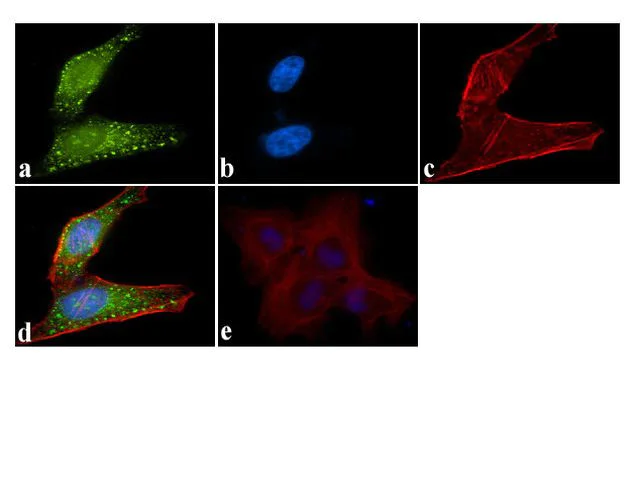
Immunocytochemistry/ Immunofluorescence - Anti-ATG4B antibody [RP23040125] (AB308052)
  • ICC/IF

Supplier Data

Immunocytochemistry/ Immunofluorescence - Anti-ATG4B antibody [RP23040125] (AB308052)

For immunofluorescence analysis, 70% confluent log phase Rapamycin treated HeLa cells (treated with 100nM of Rapamycin A for 4 hours) were fixed with 4% paraformaldehyde for 15 minutes, permeabilized with 0.25% Triton X-100 for 10 minutes, and blocked with 5% BSA for 1 hour at room temperature for detection of ATG14 using ab308052 at 2 µg/mL in 1% BSA and incubated for 3 hours at room temperature and then labeled with Alexa Fluor® 488 Goat anti-Rabbit IgG Secondary Antibody at a dilution of 1/400 for 30 minutes at room temperature (Panel a : green). Nuclei (Panel b : blue) were stained with DAPI F-actin (Panel c : red) was stained with Alexa Fluor® 594 Phalloidin Panel d is a merged image showing nuclear localization Panel e shows untreated HeLa cells Panel f shows no primary antibody control The images were captured at 20X magnification
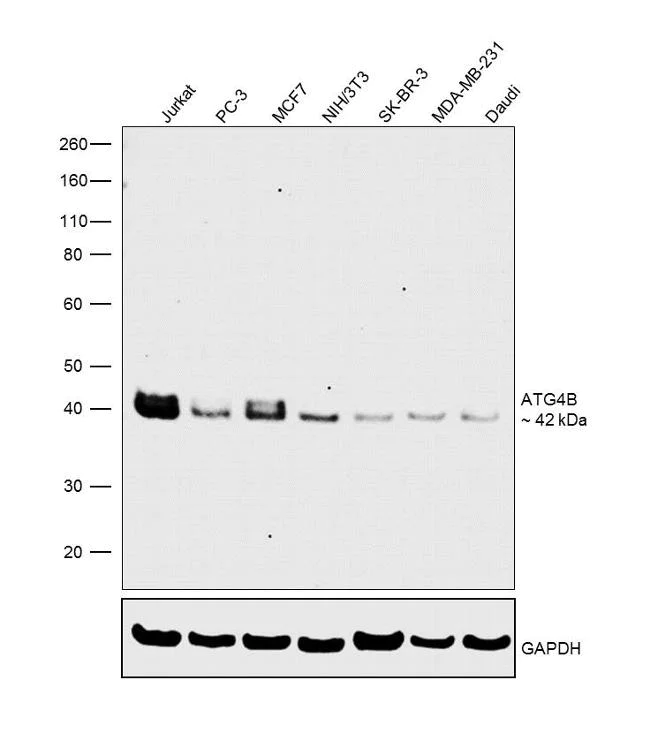
Western blot - Anti-ATG4B antibody [RP23040125] (AB308052)
  • WB

Supplier Data

Western blot - Anti-ATG4B antibody [RP23040125] (AB308052)

Western blot was performed using ab308052 at 1 µg/mL and a 42 kDa band corresponding to ATG4B was observed across all the cell lines tested. Whole cell extracts (30 µg lysate) of Jurkat (Lane 1), PC-3 (Lane 2), MCF7 (Lane 3), NIH/3T3 (Lane 4), SK-BR-3 (Lane 5), MDA-MB-231 (Lane 6) and Daudi (Lane 7) were electrophoresed 4-12% Bis-Tris Protein Gel. Resolved proteins were then transferred onto a nitrocellulose membrane. The blot was probed with ab308052 and detected by chemiluminescence with a HRP-conjugated Goat anti-Rabbit IgG (H+L) Recombinant Secondary Antibody at 1 : 4000 dilution. Chemiluminescent detection was performed (ECL).

All lanes:

Western blot - Anti-ATG4B antibody [RP23040125] (ab308052) at 1 µg/mL

Lane 1:

Jurkat cells whole cell extract at 30 µg

Lane 2:

PC-3 whole cell extract at 30 µg

Lane 3:

MCF7 whole cell extract at 30 µg

Lane 4:

NIH/3T3 whole cell extract at 30 µg

Lane 5:

SK-BR-3 whole cell extract at 30 µg

Lane 6:

MDA-MB-231 whole cell extracts at 30 µg

Lane 7:

Daudi whole cell extract at 30 µg

Secondary

All lanes:

HRP-conjugated Goat anti-Rabbit IgG (H+L) Recombinant Secondary Antibody at 1/4000 dilution

Observed band size: 42 kDa

true

关键信息

宿主种属

Rabbit

克隆

Multiclonal

克隆号

RP23040125

亚型

IgG

不含载体蛋白

No

反应种属

Human, African green monkey, Mouse, Dog

应用

ICC/IF, WB

applications

免疫原

Recombinant Full Length Protein corresponding to Human ATG4B.

Q9Y4P1

反应性数据

{ "title": "Reactivity Data", "filters": { "stats": ["", "Species", "Dilution Info", "Notes"], "tabs": { "all-applications": {"fullname" : "All Applications", "shortname": "All Applications"}, "WB" : {"fullname" : "Western blot", "shortname":"WB"}, "ICCIF" : {"fullname" : "Immunocytochemistry/ Immunofluorescence", "shortname":"ICC/IF"} }, "product-promise": { "all": "all", "testedAndGuaranteed": "tested", "guaranteed": "expected", "predicted": "predicted", "notRecommended": "not-recommended" } }, "values": { "Human": { "WB-species-checked": "testedAndGuaranteed", "WB-species-dilution-info": "1-2 µg/mL", "WB-species-notes": "<p></p>", "ICCIF-species-checked": "testedAndGuaranteed", "ICCIF-species-dilution-info": "2 µg/mL", "ICCIF-species-notes": "<p></p>" }, "Mouse": { "WB-species-checked": "testedAndGuaranteed", "WB-species-dilution-info": "1-2 µg/mL", "WB-species-notes": "<p></p>", "ICCIF-species-checked": "guaranteed", "ICCIF-species-dilution-info": "", "ICCIF-species-notes": "" }, "African green monkey": { "WB-species-checked": "testedAndGuaranteed", "WB-species-dilution-info": "1-2 µg/mL", "WB-species-notes": "<p></p>", "ICCIF-species-checked": "guaranteed", "ICCIF-species-dilution-info": "", "ICCIF-species-notes": "" }, "Dog": { "WB-species-checked": "testedAndGuaranteed", "WB-species-dilution-info": "1-2 µg/mL", "WB-species-notes": "<p></p>", "ICCIF-species-checked": "guaranteed", "ICCIF-species-dilution-info": "", "ICCIF-species-notes": "" } } }

产品详情

What are recombinant multiclonals?
Recombinant multiclonals are a mixture of recombinant antibodies co-expressed from a library of heavy and light chains. They offer several advantages including:

  • - The sensitivity of polyclonal antibodies by recognising multiple epitopes
  • - High batch-to-batch consistency and reproducibility
  • - Improved sensitivity and specificity
  • - Long-term security of supply
  • - Animal-free batch production

View our range of recombinant multiclonal antibodies.

性能和储存信息

形式
Liquid
存储溶液
Preservative: 0.09% Sodium azide Constituents: PBS
运输条件
Blue Ice
推荐的短期储存时间
1-2 weeks
推荐的短期储存条件
+4°C
推荐的长期储存条件
-20°C
分装信息
Upon delivery aliquot
储存信息
Avoid freeze / thaw cycle

补充信息

This supplementary information is collated from multiple sources and compiled automatically.

ATG4B is a cysteine protease also known as autophagin-1 with a molecular mass of approximately 45 kDa. It is involved in the autophagy process by cleaving ATG8 family proteins. This protease facilitates the lipidation of LC3 an essential component of the autophagosome membrane. You find ATG4B expressed in various tissues especially in the brain liver and muscle where it plays important roles in cellular maintenance.
Biological function summary

ATG4B functions in the cellular autophagic machinery cleaving the C-terminal of ATG8 proteins. This processing is necessary for the conjugation to phosphatidylethanolamine and integration into autophagosomes. ATG4B is part of a larger autophagic complex that also includes other critical proteins like ATG7 and ATG3 helping prepare ATG8 proteins for autophagosome creation.

Pathways

ATG4B participates in the autophagy pathway by refining the cargo processing mechanism. It interacts with the mTOR signaling pathway which influences cell survival and growth based on nutrient availability. The ATG4B enzyme is closely related to ATG7 in the pathway as both contribute to the maturation of autophagosomes.

ATG4B has significant links to cancer and neurodegenerative disorders. In cancer ATG4B activity affects tumor survival since cancer cells exploit autophagy for growth under stress conditions. In neurodegenerative diseases like Alzheimer's alterations in ATG4B activity disrupt cellular homeostasis. This disruption connects to proteins like LC3 which are pivotal in neuron survival and function.

产品实验方案

For this product, it's our understanding that no specific protocols are required. You can visit:

靶点信息

Cysteine protease that plays a key role in autophagy by mediating both proteolytic activation and delipidation of ATG8 family proteins (PubMed : 15169837, PubMed : 15187094, PubMed : 17347651, PubMed : 19322194, PubMed : 21177865, PubMed : 22302004, PubMed : 26378241, PubMed : 27527864, PubMed : 28633005, PubMed : 28821708, PubMed : 29232556, PubMed : 30076329, PubMed : 30443548, PubMed : 30661429). Required for canonical autophagy (macroautophagy), non-canonical autophagy as well as for mitophagy (PubMed : 33773106, PubMed : 33909989). The protease activity is required for proteolytic activation of ATG8 family proteins : cleaves the C-terminal amino acid of ATG8 proteins MAP1LC3A, MAP1LC3B, MAP1LC3C, GABARAPL1, GABARAPL2 and GABARAP, to reveal a C-terminal glycine (PubMed : 15169837, PubMed : 15187094, PubMed : 17347651, PubMed : 19322194, PubMed : 20818167, PubMed : 21177865, PubMed : 22302004, PubMed : 27527864, PubMed : 28287329, PubMed : 28633005, PubMed : 29458288, PubMed : 30661429). Exposure of the glycine at the C-terminus is essential for ATG8 proteins conjugation to phosphatidylethanolamine (PE) and insertion to membranes, which is necessary for autophagy (PubMed : 15169837, PubMed : 15187094, PubMed : 17347651, PubMed : 19322194, PubMed : 21177865, PubMed : 22302004). Protease activity is also required to counteract formation of high-molecular weight conjugates of ATG8 proteins (ATG8ylation) : acts as a deubiquitinating-like enzyme that removes ATG8 conjugated to other proteins, such as ATG3 (PubMed : 31315929, PubMed : 33773106). In addition to the protease activity, also mediates delipidation of ATG8 family proteins (PubMed : 15187094, PubMed : 19322194, PubMed : 28633005, PubMed : 29458288, PubMed : 32686895, PubMed : 33909989). Catalyzes delipidation of PE-conjugated forms of ATG8 proteins during macroautophagy (PubMed : 15187094, PubMed : 19322194, PubMed : 29458288, PubMed : 32686895, PubMed : 33909989). Also involved in non-canonical autophagy, a parallel pathway involving conjugation of ATG8 proteins to single membranes at endolysosomal compartments, by catalyzing delipidation of ATG8 proteins conjugated to phosphatidylserine (PS) (PubMed : 33909989). Compared to other members of the family (ATG4A, ATG4C or ATG4C), constitutes the major protein for proteolytic activation of ATG8 proteins, while it displays weaker delipidation activity than other ATG4 paralogs (PubMed : 29458288, PubMed : 30661429). Involved in phagophore growth during mitophagy independently of its protease activity and of ATG8 proteins : acts by regulating ATG9A trafficking to mitochondria and promoting phagophore-endoplasmic reticulum contacts during the lipid transfer phase of mitophagy (PubMed : 33773106).
See full target information ATG4B

Abcam Product Promise

我们致力于为您的研究提供高质量的试剂,为您科研的每一步提供支持。若我们的产品未能达到预期性能,我们向您提供 Abcam Product Promise 保障。
详情请参阅我们的条款与条件。

Please note: All products are 'FOR RESEARCH USE ONLY. NOT FOR USE IN DIAGNOSTIC OR THERAPEUTIC PROCEDURES'.

For licensing inquiries, please contact partnerships@abcam.com