JavaScript is disabled in your browser. Please enable JavaScript to view this website.
AB254288

Anti-ALK抗体[4A4]

Anti-ALK antibody [4A4]

Be the first to review this product! Submit a review

|

(1 Publication)

Mouse Monoclonal ALK antibody. Suitable for IHC-P and reacts with Human samples. Cited in 1 publication. Immunogen corresponding to Recombinant Fragment Protein within Human ALK.

查看别名

CD246, ALK tyrosine kinase receptor, Anaplastic lymphoma kinase, ALK
1 Images
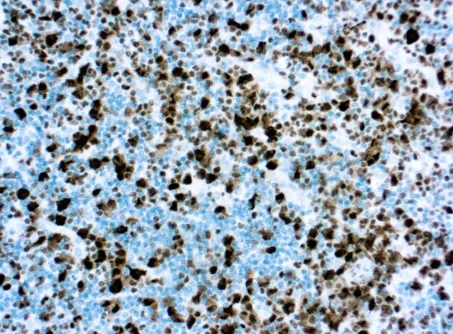
Immunohistochemistry (Formalin/PFA-fixed paraffin-embedded sections) - Anti-ALK antibody [4A4] (AB254288)
  • IHC-P

Supplier Data

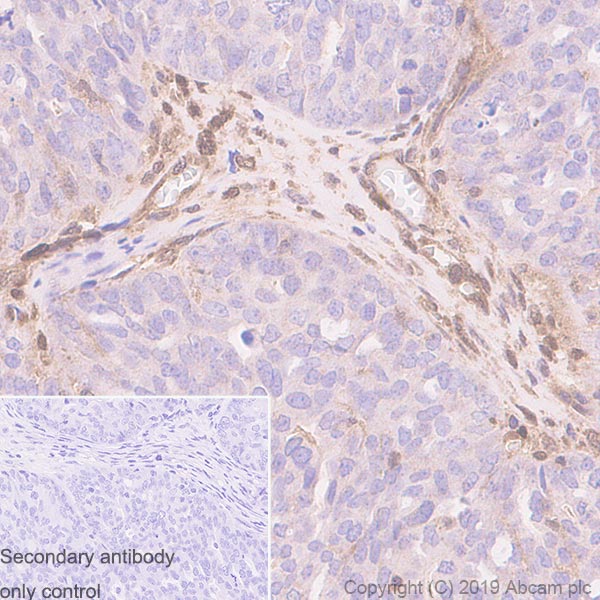
Immunohistochemistry (Formalin/PFA-fixed paraffin-embedded sections) - Anti-ALK antibody [4A4] (AB254288)

Paraffin-embedded formalin-fixed human rhabdomyosarcoma tissue labeling ALK using ab254288 at a 1/50 dilution in immunohistochemical analysis.

关键信息

宿主种属

Mouse

克隆

Monoclonal

克隆号

4A4

亚型

IgG2b

不含载体蛋白

No

反应种属

Human

应用

IHC-P

applications

免疫原

Recombinant Fragment Protein within Human ALK. The exact immunogen used to generate this antibody is proprietary information.

Q9UM73

反应性数据

{ "title": "Reactivity Data", "filters": { "stats": ["", "Species", "Dilution Info", "Notes"], "tabs": { "all-applications": {"fullname" : "All Applications", "shortname": "All Applications"}, "IHCP" : {"fullname" : "Immunohistochemistry (Formalin/PFA-fixed paraffin-embedded sections)", "shortname":"IHC-P"} }, "product-promise": { "all": "all", "testedAndGuaranteed": "tested", "guaranteed": "expected", "predicted": "predicted", "notRecommended": "not-recommended" } }, "values": { "Human": { "IHCP-species-checked": "testedAndGuaranteed", "IHCP-species-dilution-info": "1/50 - 1/100", "IHCP-species-notes": "<p>After antigen retrieval allow slides to cool down for 20 minutes prior to staining. Incubate with primary antibody for 30 mins at RT.</p>" } } }

性能和储存信息

形式
Liquid
纯化说明
Purified from TCS.
存储溶液
pH: 7.3 - 7.5 Preservative: 0.099% Sodium azide Constituents: PBS, 1% BSA
运输条件
Blue Ice
推荐的短期储存时间
1-2 weeks
推荐的短期储存条件
+4°C
推荐的长期储存条件
-20°C
分装信息
Upon delivery aliquot
储存信息
Avoid freeze / thaw cycle

补充信息

This supplementary information is collated from multiple sources and compiled automatically.

The Anaplastic Lymphoma Kinase commonly referred to as ALK is a receptor tyrosine kinase known for its role in cell signaling. It is sometimes called CD246. ALK has a molecular mass of approximately 180 kDa. This protein finds expression predominantly in the central and peripheral nervous system with prominence in neural tissue during development. The ALK protein belongs to the insulin receptor superfamily exhibiting kinase activity that promotes signal transduction processes associated with growth and differentiation.
Biological function summary

ALK influences cell growth survival and differentiation playing a significant role during the development of the nervous system. As part of its biological activity the ALK protein can become a component of larger signaling complexes participating as an important activator or mediator. Evidence suggests ALK's involvement in neuronal differentiation and synaptogenesis. Its activity impacts intracellular pathways consequently modulating biological processes relevant to neural tissue and oncogenesis.

Pathways

ALK acts within the MAPK and PI3K-AKT signaling pathways. These pathways enable the transduction of signals from the cell surface to the nucleus influencing cellular outcomes such as proliferation and survival. In these pathways ALK interacts with various other proteins including GRB2 and PI3K which further facilitate downstream signaling. Proper functioning of these pathways is essential to maintaining cellular homeostasis and development.

ALK has a significant relationship with certain types of cancer such as non-small cell lung carcinoma and anaplastic large cell lymphoma. Genetic alterations in ALK such as translocations or mutations can lead to the uncontrolled activation of its kinase activity resulting in oncogenic transformation. In these contexts the ALK protein often interacts with EML4 in lung cancer through a fusion forming an oncogenic driver. Targeting ALK with anti-ALK antibodies or small molecule inhibitors has emerged as a therapeutic strategy to manage these malignancies.

产品实验方案

For this product, it's our understanding that no specific protocols are required. You can visit:

靶点信息

Neuronal receptor tyrosine kinase that is essentially and transiently expressed in specific regions of the central and peripheral nervous systems and plays an important role in the genesis and differentiation of the nervous system (PubMed : 11121404, PubMed : 11387242, PubMed : 16317043, PubMed : 17274988, PubMed : 30061385, PubMed : 34646012, PubMed : 34819673). Also acts as a key thinness protein involved in the resistance to weight gain : in hypothalamic neurons, controls energy expenditure acting as a negative regulator of white adipose tissue lipolysis and sympathetic tone to fine-tune energy homeostasis (By similarity). Following activation by ALKAL2 ligand at the cell surface, transduces an extracellular signal into an intracellular response (PubMed : 30061385, PubMed : 33411331, PubMed : 34646012, PubMed : 34819673). In contrast, ALKAL1 is not a potent physiological ligand for ALK (PubMed : 34646012). Ligand-binding to the extracellular domain induces tyrosine kinase activation, leading to activation of the mitogen-activated protein kinase (MAPK) pathway (PubMed : 34819673). Phosphorylates almost exclusively at the first tyrosine of the Y-x-x-x-Y-Y motif (PubMed : 15226403, PubMed : 16878150). Induces tyrosine phosphorylation of CBL, FRS2, IRS1 and SHC1, as well as of the MAP kinases MAPK1/ERK2 and MAPK3/ERK1 (PubMed : 15226403, PubMed : 16878150). ALK activation may also be regulated by pleiotrophin (PTN) and midkine (MDK) (PubMed : 11278720, PubMed : 11809760, PubMed : 12107166, PubMed : 12122009). PTN-binding induces MAPK pathway activation, which is important for the anti-apoptotic signaling of PTN and regulation of cell proliferation (PubMed : 11278720, PubMed : 11809760, PubMed : 12107166). MDK-binding induces phosphorylation of the ALK target insulin receptor substrate (IRS1), activates mitogen-activated protein kinases (MAPKs) and PI3-kinase, resulting also in cell proliferation induction (PubMed : 12122009). Drives NF-kappa-B activation, probably through IRS1 and the activation of the AKT serine/threonine kinase (PubMed : 15226403, PubMed : 16878150). Recruitment of IRS1 to activated ALK and the activation of NF-kappa-B are essential for the autocrine growth and survival signaling of MDK (PubMed : 15226403, PubMed : 16878150). May function as regulator of gastric epithelial differentiation (By similarity).
See full target information ALK

文献 (1)

Recent publications for all applications. Explore the full list and refine your search

European journal of medical research 25:3 PubMed32178735

2020

miR-34a targets PAI-1 to regulate urinary microalbumin and renal function in hypertensive mice.

Applications

Unspecified application

Species

Unspecified reactive species

Ruitao Liu,Lihong Yang,Qingmin Wei
View all publications

Abcam Product Promise

我们致力于为您的研究提供高质量的试剂,为您科研的每一步提供支持。若我们的产品未能达到预期性能,我们向您提供 Abcam Product Promise 保障。
详情请参阅我们的条款与条件。

Please note: All products are 'FOR RESEARCH USE ONLY. NOT FOR USE IN DIAGNOSTIC OR THERAPEUTIC PROCEDURES'.

For licensing inquiries, please contact partnerships@abcam.com