重组Alexa Fluor® 647荧光Anti-Olig2抗体[EPR2673]
Alexa Fluor® 647 Anti-Olig2 antibody [EPR2673] - Oligodendrocyte Marker
- BOND RX™ Validated
- RabMAb
- Recombinant
- 了解详情
5
(1 Review)
|
(9 Publications)
Anti-Olig2 antibody [EPR2673] - Alexa Fluor® 647 conjugated (ab225100) is a rabbit recombinant monoclonal antibody detecting Olig2 in IHC-Fr. Suitable for Mouse, Rat.
- Biophysical QC for unrivalled batch-batch consistency
查看别名
BHLHB1, BHLHE19, PRKCBP2, RACK17, OLIG2, Oligodendrocyte transcription factor 2, Oligo2, Class B basic helix-loop-helix protein 1, Class E basic helix-loop-helix protein 19, Protein kinase C-binding protein 2, Protein kinase C-binding protein RACK17, bHLHb1, bHLHe19
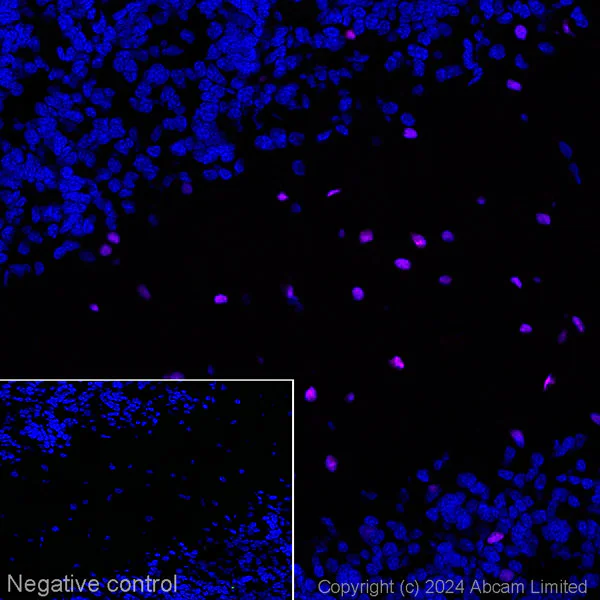
- IHC-Fr
Lab
Immunohistochemistry (Frozen sections) - Alexa Fluor® 647 Anti-Olig2 antibody [EPR2673] - Oligodendrocyte Marker (AB225100)
Immunofluorescence staining of Olig2 in a section of frozen rat cerebellum.
The section was fixed using 10% formaldehyde in 1X PBS for 10 minutes. No antigen retrieval step was performed prior to staining. Performed on a Leica BONDTM. The section was incubated at room temperature for 1 hour with ab225100 at 1/100 dilution (shown in magenta). Nuclear DNA was labelled with DAPI (shown in blue). The section was then mounted using Dako Fluorescence Mounting Medium®.
Image was taken with a confocal microscope (Leica-Microsystems, TCS SP8).
For other IHC staining systems (automated and non-automated), customers should optimize variable parameters such as antigen retrieval conditions, antibody concentrations and incubation times.
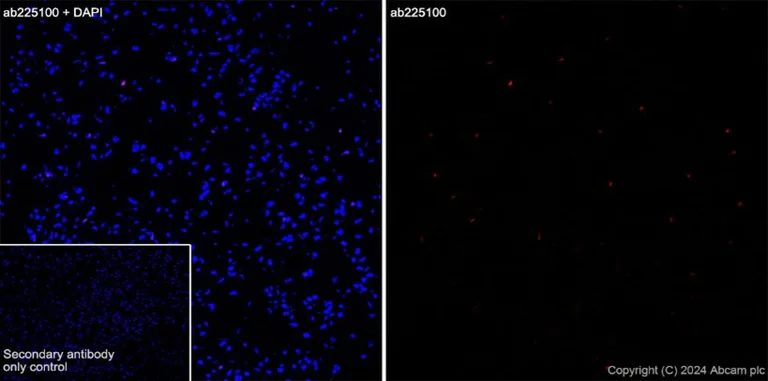
- IHC-Fr
Lab
Immunohistochemistry (Frozen sections) - Alexa Fluor® 647 Anti-Olig2 antibody [EPR2673] - Oligodendrocyte Marker (AB225100)
Immunohistochemistry (Frozen sections) analysis of Mouse cerebrum (fresh frozen) labeling Olig2 with ab225100 at 1/50. The section was fixed using 4% PFA and permeabilised with 0.2% Triton X-100. Nuclear counterstain was DAPI. Positive staining on mouse cerebrum.
不同偶联物与剂型 (6)
-
Anti-Olig2 antibody [EPR2673] - Oligodendrocyte Marker
-
Anti-Olig2 antibody [EPR2673] - BSA and Azide free
-
519 Alexa Fluor® 488
Alexa Fluor® 488 Anti-Olig2 antibody [EPR2673] - Oligodendrocyte Marker
-
565 Alexa Fluor® 555
Alexa Fluor® 555 Anti-Olig2 antibody [EPR2673]
-
603 Alexa Fluor® 568
Alexa Fluor® 568 Anti-Olig2 antibody [EPR2673] - Oligodendrocyte Marker
-
617 Alexa Fluor® 594
Alexa Fluor® 594 Anti-Olig2 antibody [EPR2673]
替代产品
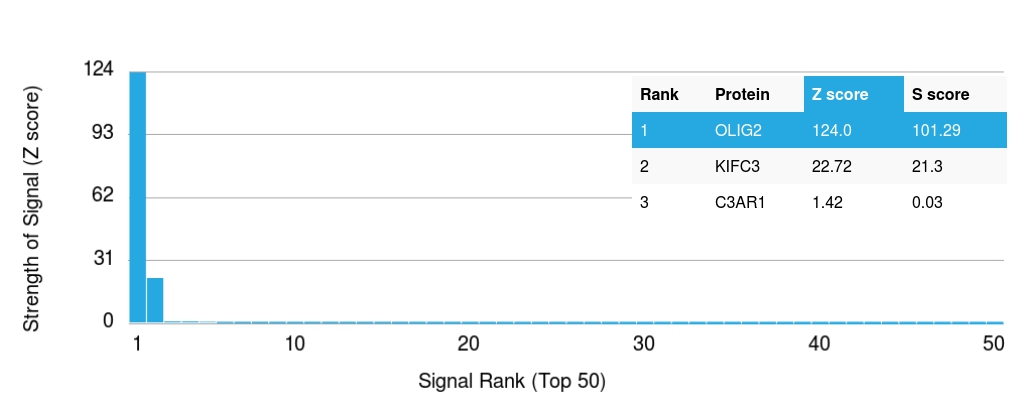
搭配使用产品
Primary Antibodies
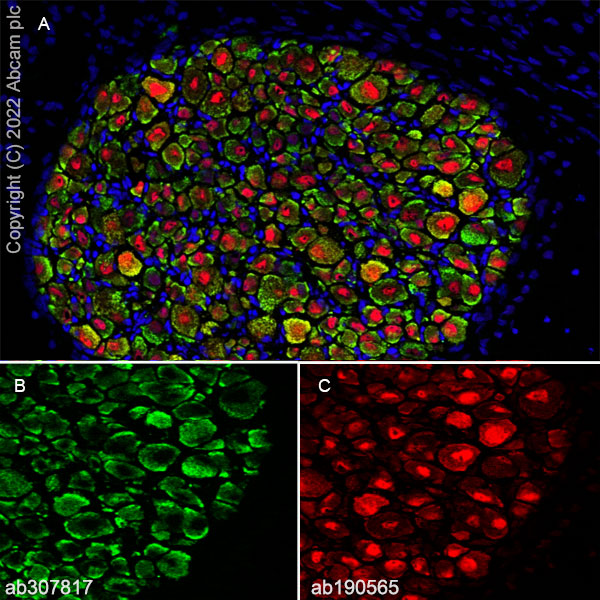
AB190565
Alexa Fluor® 647 Anti-NeuN antibody [EPR12763] - Neuronal Marker
BOND RX™ Validated|RabMAb|Recombinant
- 5
- 7
Primary Antibodies
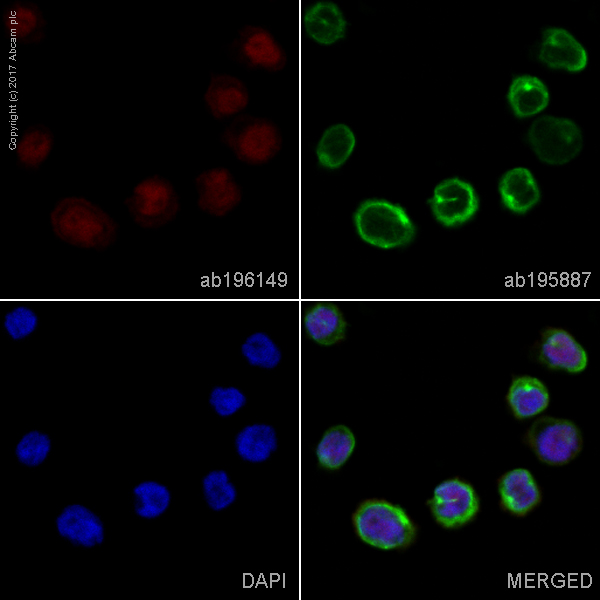
AB7349
Anti-Myelin Basic Protein antibody [12] - Oligodendrocyte Marker
BOND RX™ Validated|Recombinant|Lab Essentials
- 4
- 23
Primary Antibodies
AB278054
Anti-GFAP antibody [RM1003] - Astrocyte Marker
BOND RX™ Validated|20ul selling size|RabMAb|Recombinant
- 0
- 0
反应性数据
产品详情
What is this antibody validated in?
Alexa Fluor® 647 Anti-Olig2 antibody [EPR2673] (ab225100) is a rabbit recombinant monoclonal antibody and is validated for use in Immunohistochemistry (IHC-Fr) in Mouse, Rat samples.
Related products
Antibody clone EPR2673 is also available pre-conjugated to a variety of labels for your convenience – Anti-Olig2 Alexa Fluor® 647 [EPR2673] (ab225100).
Other related products
We have a range of other formats of antibody clone [EPR2673] also available for your convenience: ab109186, Carrier free - ab220796, Alexa Fluor® 488 - ab225099, Alexa Fluor® 647 - ab225100, Alexa Fluor® 594 - ab300729
Patented technology
Our RabMAb® technology is a patented hybridoma-based technology for making rabbit monoclonal antibodies. For details on our patents, please refer to RabMAb® patents.
What are the advantages of a recombinant monoclonal antibody?
This product is a recombinant monoclonal antibody, which offers several advantages including:
- - High batch-to-batch consistency and reproducibility
- - Improved sensitivity and specificity
- - Long-term security of supply
- - Animal-free batch production
For more information, read more on recombinant antibodies.
Alexa Fluor® is a registered trademark of Molecular Probes, Inc, a Thermo Fisher Scientific Company. The Alexa Fluor® dye included in this product is provided under an intellectual property license from Life Technologies Corporation. As this product contains the Alexa Fluor® dye, the purchase of this product conveys to the buyer the non-transferable right to use the purchased product and components of the product only in research conducted by the buyer (whether the buyer is an academic or for-profit entity). As this product contains the Alexa Fluor® dye the sale of this product is expressly conditioned on the buyer not using the product or its components, or any materials made using the product or its components, in any activity to generate revenue, which may include, but is not limited to use of the product or its components: in manufacturing; (ii) to provide a service, information, or data in return for payment (iii) for therapeutic, diagnostic or prophylactic purposes; or (iv) for resale, regardless of whether they are sold for use in research. For information on purchasing a license to this product for purposes other than research, contact Life Technologies Corporation, 5781 Van Allen Way, Carlsbad, CA 92008 USA or outlicensing@thermofisher.com.
性能和储存信息
形式
纯化工艺
存储溶液
运输条件
推荐的短期储存时间
推荐的短期储存条件
推荐的长期储存条件
分装信息
储存信息
补充信息
This supplementary information is collated from multiple sources and compiled automatically.
Biological function summary
Olig2 regulates gene expression important for the proper development of the central nervous system. It functions both independently and as a part of transcriptional complexes to influence the fate of neural progenitors. In particular its presence decides whether these progenitors will differentiate into neurons astrocytes or oligodendrocytes. Among the proteins it interacts with are factors that modulate neurogenesis and myelination highlighting its importance in maintaining normal brain homeostasis.
Pathways
Olig2 plays an important role in the oligodendrocyte differentiation and motor neuron generation pathways. It works closely with proteins such as SOX10 and NKX2.2 to regulate oligodendrocyte maturation. In the motor neuron pathway Olig2 interacts with proteins like NKX6.1 and LHX3 coordinating the development of motor neurons. These pathways demonstrate Olig2's function as a critical transcription factor influencing neural development and plasticity.
产品实验方案
- Visit the General protocols
- Visit the Troubleshooting
靶点信息
文献 (9)
Recent publications for all applications. Explore the full list and refine your search
Nature 646:676-686 PubMed40770097
2025
Applications
Unspecified application
Species
Unspecified reactive species
Journal of proteome research 23:3847-3857 PubMed39056441
2024
Applications
Unspecified application
Species
Unspecified reactive species
Nature neuroscience 26:1701-1712 PubMed37749256
2023
Applications
Unspecified application
Species
Unspecified reactive species
Immunity 56:2152-2171.e13 PubMed37582369
2023
Applications
Unspecified application
Species
Unspecified reactive species
Molecular cell 82:4647-4663.e8 PubMed36525955
2022
Applications
Unspecified application
Species
Unspecified reactive species
Cell 185:2184-2199.e16 PubMed35649412
2022
Applications
Unspecified application
Species
Unspecified reactive species
Nature neuroscience 25:285-294 PubMed35210624
2022
Applications
Unspecified application
Species
Unspecified reactive species
Nature protocols 16:1629-1646 PubMed33495627
2021
Applications
Unspecified application
Species
Unspecified reactive species
Frontiers in molecular neuroscience 13:232 PubMed33343295
2020
Applications
Unspecified application
Species
Unspecified reactive species
Abcam Product Promise
Please note: All products are 'FOR RESEARCH USE ONLY. NOT FOR USE IN DIAGNOSTIC OR THERAPEUTIC PROCEDURES'.
For licensing inquiries, please contact partnerships@abcam.com