重组Alexa Fluor® 647荧光Anti-EpCAM抗体[EPR20533-63]
Alexa Fluor® 647 Anti-EpCAM antibody [EPR20533-63]
- RabMAb
- Recombinant
- 了解详情
Be the first to review this product! Submit a review
|
(2 Publications)
Rabbit Recombinant Monoclonal EPCAM antibody - conjugated to Alexa Fluor® 647. Suitable for Flow Cyt, ICC/IF, IHC-P and reacts with Mouse samples. Cited in 2 publications.
查看别名
CD326, Tacstd1, Epcam, Epithelial cell adhesion molecule, Ep-CAM, Epithelial glycoprotein 314, Protein 289A, Tumor-associated calcium signal transducer 1, EGP314, mEGP314
- Flow Cyt
Lab
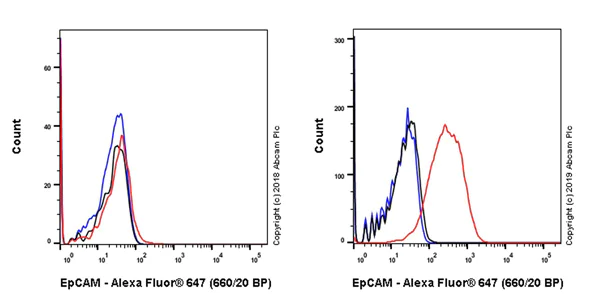
Flow Cytometry - Alexa Fluor® 647 Anti-EpCAM antibody [EPR20533-63] (AB237385)
Flow cytometric analysis of unfixed 4T1 (right) and NIH/3T3 (left) cells with ab237385 (red line). The cells were incubated in 1x PBS / 10% normal goat serum to block non-specific protein-protein interactions followed by the antibody (ab237385, 1/50 dilution) for 30 min at 22°C.
Isotype control antibody (black line) was Rabbit IgG (monoclonal) Alexa Fluor® 647 (ab199093) used at the same concentration and conditions as the primary antibody. Unlabelled sample (blue line) was also used as a control.
Acquisition of >5,000 events were collected using a 17mW red Helium-Neon laser (633nm) and 660/20 bandpass filter.
- ICC/IF
Lab
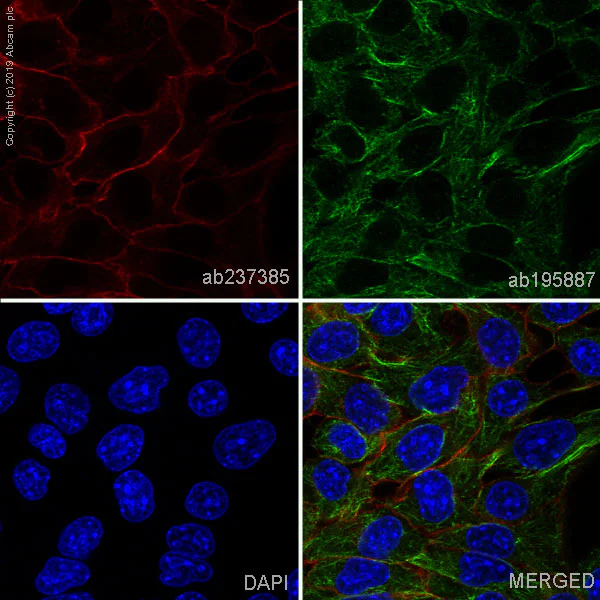
Immunocytochemistry/ Immunofluorescence - Alexa Fluor® 647 Anti-EpCAM antibody [EPR20533-63] (AB237385)
ab237385 staining EpCAM in 4T1 cells. The cells were fixed with 100% methanol (5 min), and then incubated in 1% BSA/10% normal goat serum/0.3M glycine in 0.1% PBS-Tween for 1h to permeabilize the cells and block non-specific protein-protein interactions.
The cells were then incubated overnight at +4°C with ab237385 at 1/200 dilution (shown in red) and ab195887, Mouse monoclonal to alpha Tubulin (Alexa Fluor® 488), at 1/250 dilution (shown in green). Nuclear DNA was labelled with DAPI (shown in blue).
Image was taken with a confocal microscope (Leica-Microsystems, TCS SP8).
- ICC/IF
Lab
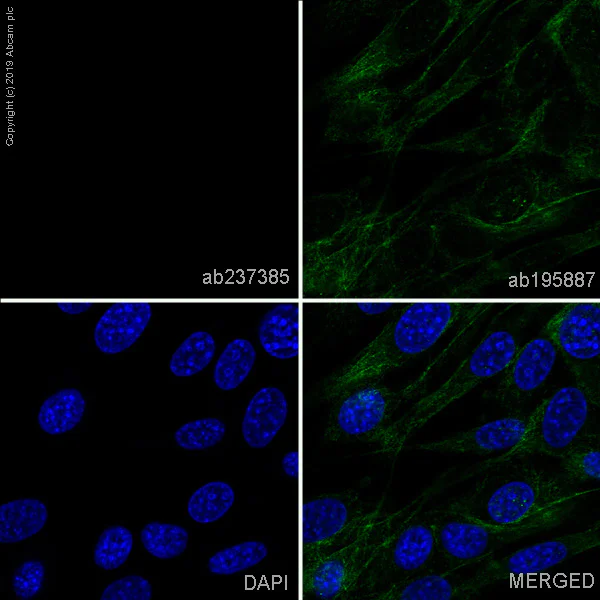
Immunocytochemistry/ Immunofluorescence - Alexa Fluor® 647 Anti-EpCAM antibody [EPR20533-63] (AB237385)
ab237385 showing no staining of EpCAM in NIH3T3 cells. The cells were fixed with 100% methanol (5 min), and then incubated in 1% BSA/10% normal goat serum/0.3M glycine in 0.1% PBS-Tween for 1h to permeabilize the cells and block non-specific protein-protein interactions.
The cells were then incubated overnight at +4°C with ab237385 at 1/200 dilution (shown in red) and ab195887, Mouse monoclonal to alpha Tubulin (Alexa Fluor® 488), at 1/250 dilution (shown in green). Nuclear DNA was labelled with DAPI (shown in blue).
Image was taken with a confocal microscope (Leica-Microsystems, TCS SP8).
- Flow Cyt
Lab
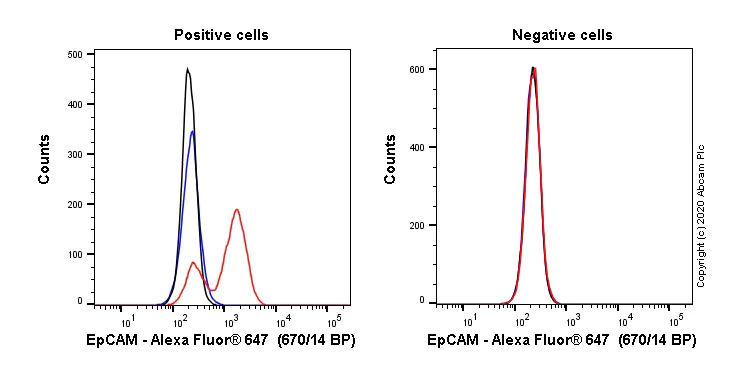
Flow Cytometry - Alexa Fluor® 647 Anti-EpCAM antibody [EPR20533-63] (AB237385)
Flow cytometry overlay histogram showing M158 positive cells (left) and negative NIH/3T3 cells (right) stained with ab237385 (red line). The cells were incubated in 1x PBS containing 10 % normal goat serum to block non-specific protein-protein interaction followed by the antibody (ab237385) (1x 10⁶ in 100 μl at 0.1 μg/ml (1/5000)) for 30 min on ice.
Isotype control antibody (black line) was Rabbit IgG (monoclonal) Alexa Fluor® 647 (ab199093) used at the same concentration and conditions as the primary antibody. Unlabelled sample (blue line) was also used as a control.
Acquisition of >5,000 events were collected using a 40 mW Red laser (640nm) and 670/14 bandpass filter.
不同偶联物与剂型 (4)
-
Anti-EpCAM antibody [EPR20533-63]
-
Anti-EpCAM antibody [EPR20533-63] - BSA and Azide free
-
519 Alexa Fluor® 488
Alexa Fluor® 488 Anti-EpCAM antibody [EPR20533-63]
-
578 PE
PE Anti-EpCAM antibody [EPR20533-63]
替代产品
Primary Antibodies
AB124825
Anti-EpCAM antibody [EPR677(2)]
BOND RX™ Validated|20ul selling size|RabMAb|Recombinant

- 1
- 1
Primary Antibodies
AB225894
Anti-EpCAM antibody [EPR20532-225] - BSA and Azide free
BOND RX™ Validated|RabMAb|Advanced Validation|Recombinant|KO Validated
- 0
- 0
Primary Antibodies
AB213501
Anti-EpCAM antibody [EPR20533-266]
20ul selling size|RabMAb|Recombinant
- 0
- 0
Primary Antibodies
AB32392
20ul selling size|RabMAb|Recombinant|KO Validated

- 4
- 19
Primary Antibodies
AB223582
Anti-EpCAM antibody [EPR20532-225]
BOND RX™ Validated|20ul selling size|RabMAb|Advanced Validation|Recombinant|KO Validated
- 5
- 2
搭配使用产品
Primary Antibodies
AB193895
Alexa Fluor® 647 Anti-Cytokeratin 5 antibody [EP1601Y]
BOND RX™ Validated|RabMAb|Recombinant
- 5
- 4
Primary Antibodies
AB303477
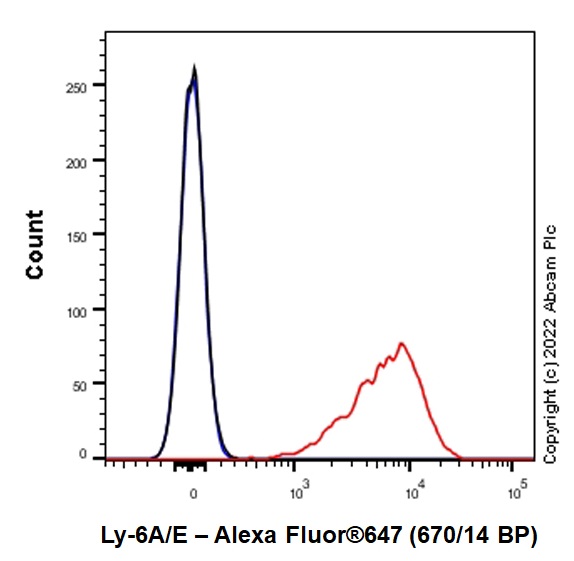
Alexa Fluor® 647 Anti-Ly-6A/E (Sca-1) antibody [EPR22502-38]
RabMAb|Recombinant
- 0
- 0
反应性数据
产品详情
Patented technology
Our RabMAb® technology is a patented hybridoma-based technology for making rabbit monoclonal antibodies. For details on our patents, please refer to RabMAb® patents.
What are the advantages of a recombinant monoclonal antibody?
This product is a recombinant monoclonal antibody, which offers several advantages including:
- - High batch-to-batch consistency and reproducibility
- - Improved sensitivity and specificity
- - Long-term security of supply
- - Animal-free batch production
For more information, read more on recombinant antibodies.
Alexa Fluor® is a registered trademark of Molecular Probes, Inc, a Thermo Fisher Scientific Company. The Alexa Fluor® dye included in this product is provided under an intellectual property license from Life Technologies Corporation. As this product contains the Alexa Fluor® dye, the purchase of this product conveys to the buyer the non-transferable right to use the purchased product and components of the product only in research conducted by the buyer (whether the buyer is an academic or for-profit entity). As this product contains the Alexa Fluor® dye the sale of this product is expressly conditioned on the buyer not using the product or its components, or any materials made using the product or its components, in any activity to generate revenue, which may include, but is not limited to use of the product or its components: in manufacturing; (ii) to provide a service, information, or data in return for payment (iii) for therapeutic, diagnostic or prophylactic purposes; or (iv) for resale, regardless of whether they are sold for use in research. For information on purchasing a license to this product for purposes other than research, contact Life Technologies Corporation, 5781 Van Allen Way, Carlsbad, CA 92008 USA or outlicensing@thermofisher.com.
性能和储存信息
形式
纯化工艺
存储溶液
运输条件
推荐的短期储存时间
推荐的短期储存条件
推荐的长期储存条件
分装信息
储存信息
补充信息
This supplementary information is collated from multiple sources and compiled automatically.
Biological function summary
EpCAM facilitates signaling pathways that impact cellular processes like proliferation and differentiation. It is not a part of a larger protein complex but interacts directly with other cellular machinery to transmit intracellular signals. EpCAM influences stem cell behavior and is important in tissue homeostasis assisting in both normal regenerative processes and wound healing.
Pathways
EpCAM participates in regulatory mechanisms involving the Wnt/β-catenin signaling pathway which affects gene expression and cell fate decisions. Through its action EpCAM modulates components like E-cadherin which is important for cell adhesion and the maintenance of the epithelial layer. It indirectly influences pathways relating to MYC a transcription factor that regulates cell cycle progression and apoptosis.
产品实验方案
- Visit the General protocols
- Visit the Troubleshooting
靶点信息
文献 (2)
Recent publications for all applications. Explore the full list and refine your search
Physiological reports 13:e70264 PubMed40051209
2025
Applications
Unspecified application
Species
Unspecified reactive species
Nature communications 12:289 PubMed33436554
2021
Applications
Unspecified application
Species
Unspecified reactive species
Abcam Product Promise
Please note: All products are 'FOR RESEARCH USE ONLY. NOT FOR USE IN DIAGNOSTIC OR THERAPEUTIC PROCEDURES'.
For licensing inquiries, please contact partnerships@abcam.com