重组Alexa Fluor® 488荧光Anti-Ki67抗体[SP6]
Alexa Fluor® 488 Anti-Ki67 antibody [SP6]
- RabMAb®
- Recombinant
- 了解详情
5
(1 Review)
|
(11 Publications)
Anti-Ki67 antibody [SP6] - Alexa Fluor® 488 conjugated (ab281847) is a rabbit recombinant monoclonal antibody detecting Ki67 in Flow Cytometry (Intra), IHC-P, ICC/IF. Suitable for Human, Mouse.
- Clone SP6 is the most cited clone to Ki67
- Biophysical QC for unrivalled batch-batch consistency
查看别名
Proliferation marker protein Ki-67, Antigen identified by monoclonal antibody Ki-67, Antigen KI-67, Antigen Ki67, MKI67
- Flow Cyt (Intra)
Supplier Data
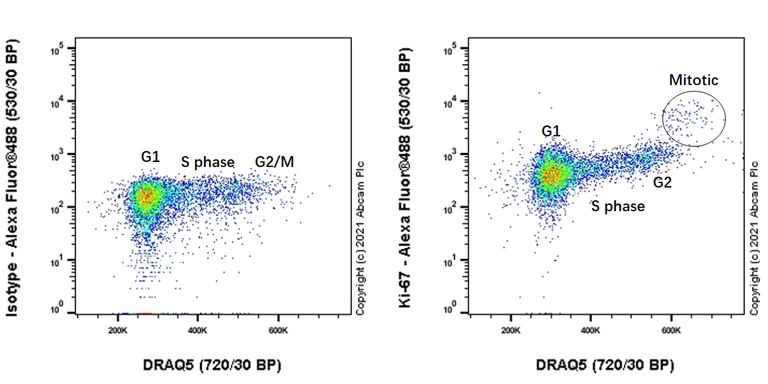
Flow Cytometry (Intracellular) - Alexa Fluor® 488 Anti-Ki67 antibody [SP6] (AB281847)
Flow cytometric analysis of 4% paraformaldehyde fixed 90% methanol permeabilized HeLa (Human cervix adenocarcinoma cell) cells labelling Ki67 with ab281847 at 1/5000 dilution (0.01μg) (Right) compared with a Rabbit monoclonal isotype control - Alexa Fluor® 488 (Left) isotype control and an unlabelled control (cells without incubation with primary antibody and secondary antibody) (Blue).
Cells were co-stained with DRAQ5 to differentiate cell cycle phase.

- ICC/IF
Supplier Data
Immunocytochemistry/ Immunofluorescence - Alexa Fluor® 488 Anti-Ki67 antibody [SP6] (AB281847)
Immunofluorescent analysis of 4% Paraformaldehyde-fixed, 0.1% TritonX-100 permeabilized HeLa cells labelling Ki67 with ab281847 at 1/50 dilution (10.0 μg/ml) (Green).
Confocal image showing nucleolar staining in HeLa cells. ab195889 Anti-alpha Tubulin mouse monoclonal antibody - Microtubule Marker (Alexa Fluor® 594) was used to counterstain tubulin at 1/200 dilution (Red). The Nuclear counterstain was DAPI (Blue).
- IHC-P
Supplier Data
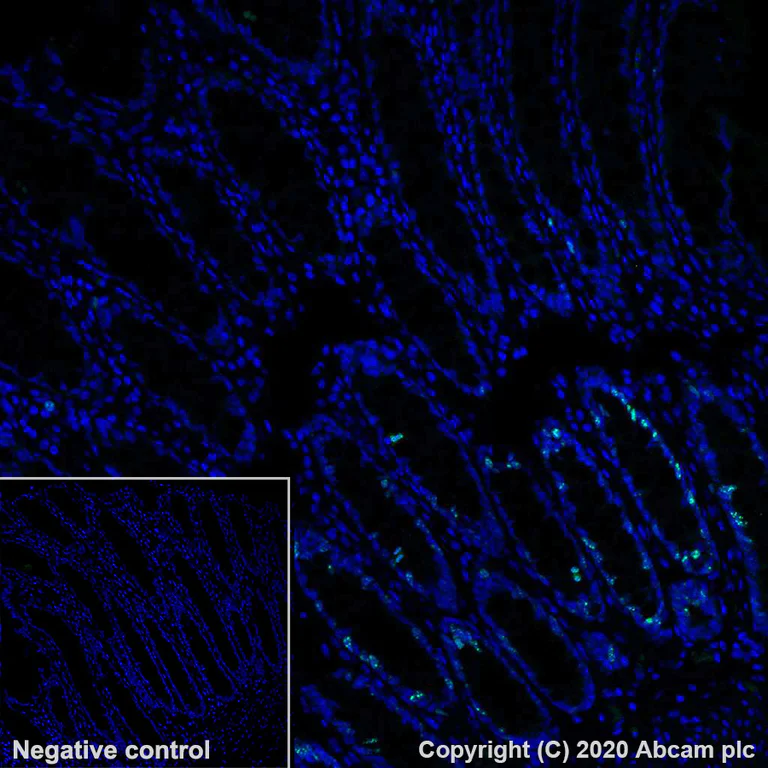
Immunohistochemistry (Formalin/PFA-fixed paraffin-embedded sections) - Alexa Fluor® 488 Anti-Ki67 antibody [SP6] (AB281847)
Immunohistochemical analysis of paraffin-embedded Human colon tissue labeling Ki67 with ab281847.
Positive staining on human colon. The section was then incubated overnight at +4°C in TBS containing 0.025% (v/v) Triton X-100 and 1% (w/v) BSA with ab281847 at 1/100 dilution (shown in green). Nuclear DNA was labeled with DAPI (shown in blue). The section was then mounted using Fluoromount®. Non-specific protein-protein interactions were then blocked in TBS containing 0.025% (v/v) Triton X-100, 0.3M (w/v) glycine and 1% (w/v) BSA for 1h at room temperature. Image was taken with a confocal microscope (Leica-Microsystems, TCS SP8).
Heat mediated antigen retrieval using ab93684 (Tris/EDTA buffer, pH 9.0)
- IHC-P
Supplier Data
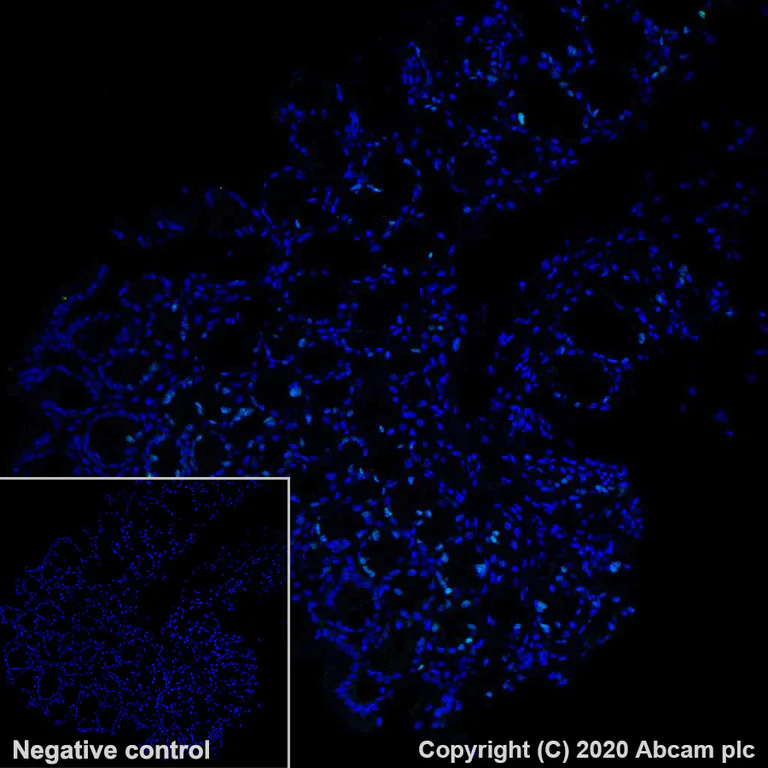
Immunohistochemistry (Formalin/PFA-fixed paraffin-embedded sections) - Alexa Fluor® 488 Anti-Ki67 antibody [SP6] (AB281847)
Immunohistochemical analysis of paraffin-embedded Mouse colon tissue labeling Ki67 with ab281847.
Positive staining on mouse colon. The section was then incubated overnight at +4°C in TBS containing 0.025% (v/v) Triton X-100 and 1% (w/v) BSA with ab281847 at 1/100 dilution (shown in green). Nuclear DNA was labeled with DAPI (shown in blue). The section was then mounted using Fluoromount®. Non-specific protein-protein interactions were then blocked in TBS containing 0.025% (v/v) Triton X-100, 0.3M (w/v) glycine and 1% (w/v) BSA for 1h at room temperature. Image was taken with a confocal microscope (Leica-Microsystems, TCS SP8).
Heat mediated antigen retrieval using ab93684 (Tris/EDTA buffer, pH 9.0)
不同偶联物与剂型 (8)
-
Anti-Ki67 antibody [SP6]
-
Anti-Ki67 antibody [SP6], prediluted
-
Anti-Ki67 antibody [SP6] - BSA free
-
Anti-Ki67 [SP6] – Chicken IgY (Chimeric)
-
Anti-Ki67 [SP6] – Chicken IgY (Chimeric) – BSA and Azide Free
-
660 APC
APC Anti-Ki67 antibody [SP6]
-
665 Alexa Fluor® 647
Alexa Fluor® 647 Anti-Ki67 antibody [SP6]
-
578 PE
PE Anti-Ki67 antibody [SP6]
搭配使用产品
Primary Antibodies
AB315292
Alexa Fluor® 647 Anti-CD62L antibody [EPR17012-27]
RabMAb|Recombinant

- 0
- 0
反应性数据
产品详情
What is this antibody validated in?
Alexa Fluor® 488 Anti-Ki67 antibody [SP6] (ab281847) is a rabbit recombinant monoclonal antibody and is validated for use in Flow Cytometry (Intra), Immunohistochemistry (IHC-P), Immunocytochemistry/immunofluorescence (ICC/IF) in Human, Mouse samples.
Collaboration
Anti-Ki67 [SP6] Alexa Fluor® 488 (ab281847) is a clone from the portfolio of Spring Bioscience (Roche) SP clones which have been optimised for immunohistochemistry (IHC).
Related products
Antibody clone SP6 is also available pre-conjugated to a variety of labels for your convenience – Anti-Ki67 Alexa Fluor® 488 [SP6] (ab281847).
Other related products
We have a range of other formats of antibody clone [SP6] also available for your convenience: ab16667, ab21700, Carrier free - ab197547, ab231172, ab238624, Oligonucleotide - ab279361, Alexa Fluor® 488 - ab281847, Alexa Fluor® 647 - ab281928, PE - ab282173, APC - ab314285, ab320709, Carrier free - ab320710, ab323292
Patented technology
Our RabMAb® technology is a patented hybridoma-based technology for making rabbit monoclonal antibodies. For details on our patents, please refer to RabMAb® patents.
What are the advantages of a recombinant monoclonal antibody?
This product is a recombinant monoclonal antibody, which offers several advantages including:
- - High batch-to-batch consistency and reproducibility
- - Improved sensitivity and specificity
- - Long-term security of supply
- - Animal-free batch production
For more information, read more on recombinant antibodies.
Alexa Fluor® is a registered trademark of Molecular Probes, Inc, a Thermo Fisher Scientific Company. The Alexa Fluor® dye included in this product is provided under an intellectual property license from Life Technologies Corporation. As this product contains the Alexa Fluor® dye, the purchase of this product conveys to the buyer the non-transferable right to use the purchased product and components of the product only in research conducted by the buyer (whether the buyer is an academic or for-profit entity). As this product contains the Alexa Fluor® dye the sale of this product is expressly conditioned on the buyer not using the product or its components, or any materials made using the product or its components, in any activity to generate revenue, which may include, but is not limited to use of the product or its components: in manufacturing; (ii) to provide a service, information, or data in return for payment (iii) for therapeutic, diagnostic or prophylactic purposes; or (iv) for resale, regardless of whether they are sold for use in research. For information on purchasing a license to this product for purposes other than research, contact Life Technologies Corporation, 5781 Van Allen Way, Carlsbad, CA 92008 USA or outlicensing@thermofisher.com.
性能和储存信息
形式
纯化工艺
存储溶液
运输条件
推荐的短期储存时间
推荐的短期储存条件
推荐的长期储存条件
分装信息
储存信息
补充信息
This supplementary information is collated from multiple sources and compiled automatically.
Biological function summary
The Ki67 protein plays an essential role in cellular proliferation processes. It does not form part of a stable complex but interacts transiently with other cell cycle-related proteins. Research indicates that Ki67 maintains the structure of the perichromosomal layer during mitosis impacting chromosome separation. It is particularly active in tissues with high cell turnover such as bone marrow and lymphoid organs.
Pathways
Ki67 influences several key cellular pathways that control cell proliferation and differentiation. The protein acts within the regulation of the cell cycle and the PI3K/AKT signaling pathway important for cell growth and survival. Within these pathways Ki67 interacts with proteins like cyclin-dependent kinases (CDKs) which regulate transitions between different phases of the cell cycle.
产品实验方案
- Visit the General protocols
- Visit the Troubleshooting
靶点信息
文献 (11)
Recent publications for all applications. Explore the full list and refine your search
Frontiers in pharmacology 16:1611637 PubMed40693271
2025
Applications
Unspecified application
Species
Unspecified reactive species
Drug design, development and therapy 19:2677-2691 PubMed40226128
2025
Applications
Unspecified application
Species
Unspecified reactive species
Bioactive materials 48:414-430 PubMed40083774
2025
Applications
Unspecified application
Species
Unspecified reactive species
Communications biology 8:296 PubMed40033126
2025
Applications
Unspecified application
Species
Unspecified reactive species
Molecular medicine (Cambridge, Mass.) 31:37 PubMed39901071
2025
Applications
Unspecified application
Species
Unspecified reactive species
Nature immunology 25:2152-2165 PubMed39438660
2024
Applications
Unspecified application
Species
Unspecified reactive species
Frontiers in veterinary science 11:1385395 PubMed38725585
2024
Applications
Unspecified application
Species
Unspecified reactive species
Archiv der Pharmazie 357:e2400063 PubMed38704748
2024
Applications
Unspecified application
Species
Unspecified reactive species
Frontiers in veterinary science 10:1154987 PubMed37346276
2023
Applications
Unspecified application
Species
Unspecified reactive species
Computational and mathematical methods in medicine 2022:8388473 PubMed35664641
2022
Applications
Unspecified application
Species
Unspecified reactive species
Abcam Product Promise
Please note: All products are 'FOR RESEARCH USE ONLY. NOT FOR USE IN DIAGNOSTIC OR THERAPEUTIC PROCEDURES'.
For licensing inquiries, please contact partnerships@abcam.com