JavaScript is disabled in your browser. Please enable JavaScript to view this website.
AB79039

Anti-AIPL1抗体

Anti-AIPL1 antibody

Be the first to review this product! Submit a review

|

(2 Publications)

Rabbit Polyclonal AIPL1 antibody. Suitable for WB, IHC-P, ICC/IF and reacts with Human samples. Cited in 2 publications. Immunogen corresponding to Synthetic Peptide within Human AIPL1.

查看别名

AIPL2, AIPL1, Aryl-hydrocarbon-interacting protein-like 1
3 Images
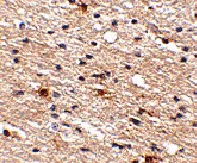
Immunohistochemistry (Formalin/PFA-fixed paraffin-embedded sections) - Anti-AIPL1 antibody (AB79039)
  • IHC-P

Supplier Data

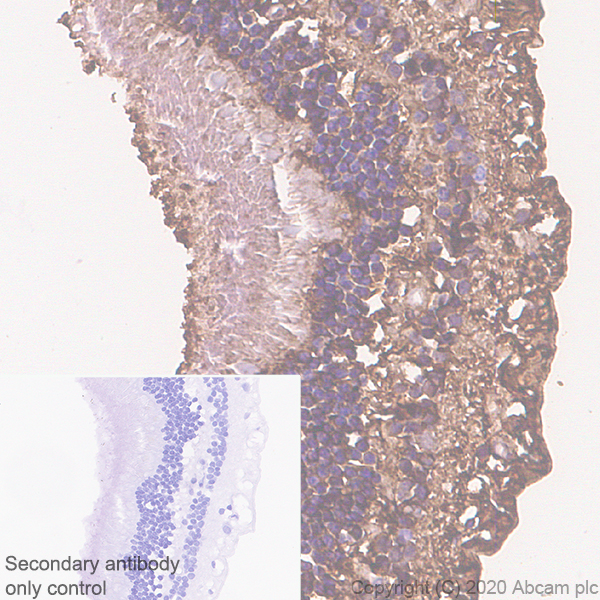
Immunohistochemistry (Formalin/PFA-fixed paraffin-embedded sections) - Anti-AIPL1 antibody (AB79039)

Immunohistochemistry of Human brain tisue using ab79039 at 2.5 μg/ml.
Immunocytochemistry/ Immunofluorescence - Anti-AIPL1 antibody (AB79039)
  • ICC/IF

Unknown

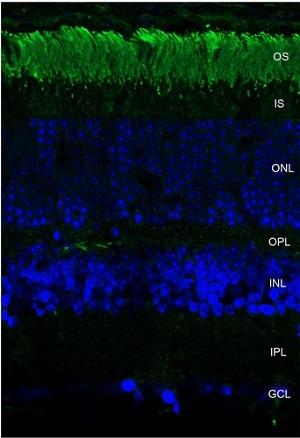
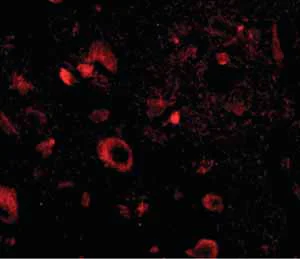
Immunocytochemistry/ Immunofluorescence - Anti-AIPL1 antibody (AB79039)

Immunofluorescence of AIPL1 in Human brain tissue with ab79039 at 20 ug/mL.
Western blot - Anti-AIPL1 antibody (AB79039)
  • WB

Unknown

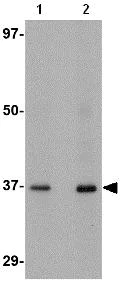
Western blot - Anti-AIPL1 antibody (AB79039)

Lane 1:

Western blot - Anti-AIPL1 antibody (ab79039) at 1 µg/mL

Lane 2:

Western blot - Anti-AIPL1 antibody (ab79039) at 2 µg/mL

All lanes:

Human brain tissue lysate at 15 µg

Predicted band size: 44 kDa

Observed band size: 36 kDa

false

关键信息

宿主种属

Rabbit

克隆

Polyclonal

亚型

IgG

不含载体蛋白

No

反应种属

Human

应用

IHC-P, ICC/IF, WB

applications

免疫原

Synthetic Peptide within Human AIPL1. The exact immunogen used to generate this antibody is proprietary information.

Q9NZN9

反应性数据

{ "title": "Reactivity Data", "filters": { "stats": ["", "Species", "Dilution Info", "Notes"], "tabs": { "all-applications": {"fullname" : "All Applications", "shortname": "All Applications"}, "WB" : {"fullname" : "Western blot", "shortname":"WB"}, "IHCP" : {"fullname" : "Immunohistochemistry (Formalin/PFA-fixed paraffin-embedded sections)", "shortname":"IHC-P"}, "ICCIF" : {"fullname" : "Immunocytochemistry/ Immunofluorescence", "shortname":"ICC/IF"} }, "product-promise": { "all": "all", "testedAndGuaranteed": "tested", "guaranteed": "expected", "predicted": "predicted", "notRecommended": "not-recommended" } }, "values": { "Human": { "WB-species-checked": "testedAndGuaranteed", "WB-species-dilution-info": "1-2 µg/mL", "WB-species-notes": "<p></p>", "IHCP-species-checked": "testedAndGuaranteed", "IHCP-species-dilution-info": "", "IHCP-species-notes": "<p></p>", "ICCIF-species-checked": "testedAndGuaranteed", "ICCIF-species-dilution-info": "20 µg/mL", "ICCIF-species-notes": "<p></p>" } } }

性能和储存信息

形式
Liquid
纯化工艺
Affinity purification Immunogen
纯化说明
ab79039 was purified by affinity chromatography via a peptide column
存储溶液
pH: 7.2 Preservative: 0.02% Sodium azide Constituents: PBS
运输条件
Blue Ice
推荐的短期储存条件
+4°C
推荐的长期储存条件
+4°C

补充信息

This supplementary information is collated from multiple sources and compiled automatically.

AIPL1 also known as aryl hydrocarbon receptor-interacting protein-like 1 is a protein that plays an important mechanical role in the cellular environment. It has a molecular mass of approximately 42 kDa. AIPL1 is expressed mainly in the retina further appearing in photoreceptor cells where its function becomes important for proper cell operation. This protein interacts with other molecular structures directly affecting processes essential to cellular function.
Biological function summary

AIPL1 assists in maintaining the stability and proper folding of photoreceptor PDE6 a cyclic GMP phosphodiesterase an important component of the phototransduction complex. It acts as a chaperone ensuring that PDE6 which is critical for visual processes stays correctly assembled and functional. Its role in this complex highlights its involvement in the health of photoreceptor cells and indirectly supports the conversion of light into neural signals within the eye.

Pathways

AIPL1 participates significantly within the phototransduction pathway. This is a vital pathway required for vision where it directly influences the regulation of PDE6 activity. AIPL1's association with PDE6 links it to further elements like the guanylate cyclase pathway important for replenishing cGMP levels post-phototransduction. Interactions with proteins such as chaperonin-containing TCP-1 (CCT) highlight its role in the folding and proper functioning of phototransduction components.

Mutations in AIPL1 are associated with Leber congenital amaurosis (LCA) a severe inherited retinal dystrophy that leads to blindness or severe vision impairment from a young age. The loss of function or malfunction of AIPL1 affects PDE6 leading to the buildup of misfolded proteins which impairs photoreceptor cell survival and function. Additionally study of similar AIPL1 mutations sheds light on a subset of retinitis pigmentosa linking abnormalities within this protein to progressive vision disorders.

产品实验方案

For this product, it's our understanding that no specific protocols are required. You can visit:

靶点信息

May be important in protein trafficking and/or protein folding and stabilization.
See full target information AIPL1

文献 (2)

Recent publications for all applications. Explore the full list and refine your search

Cell reports 43:113784 PubMed38386560

2024

Single-cell spatial transcriptomic and translatomic profiling of dopaminergic neurons in health, aging, and disease.

Applications

Unspecified application

Species

Unspecified reactive species

Peter Kilfeather,Jia Hui Khoo,Katherina Wagner,Han Liang,Maria Claudia Caiazza,Yanru An,Xingju Zhang,Xiaoyan Chen,Natalie Connor-Robson,Zhouchun Shang,Richard Wade-Martins

Frontiers in oncology 11:766790 PubMed34976812

2021

SIPL1, Regulated by MAZ, Promotes Tumor Progression and Predicts Poor Survival in Human Triple-Negative Breast Cancer.

Applications

Unspecified application

Species

Unspecified reactive species

Juanjuan He,Jing Wang,Teng Li,Kunlun Chen,Songchao Li,Shaojin Zhang
View all publications

Abcam Product Promise

我们致力于为您的研究提供高质量的试剂,为您科研的每一步提供支持。若我们的产品未能达到预期性能,我们向您提供 Abcam Product Promise 保障。
详情请参阅我们的条款与条件。

Please note: All products are 'FOR RESEARCH USE ONLY. NOT FOR USE IN DIAGNOSTIC OR THERAPEUTIC PROCEDURES'.

For licensing inquiries, please contact partnerships@abcam.com