JavaScript is disabled in your browser. Please enable JavaScript to view this website.
AB288318

Substance P ELISA试剂盒

Substance P ELISA Kit

Be the first to review this product! Submit a review

|

(2 Publications)

Substance P ELISA Kit is a competitive ELISA designed to quantify Substance P with a sensitivity of 5.3 pg/mL

- Colorimetric competitive ELISA - 450 nm readout - works on any plate reader
- Wide dynamic range - quantifies 9.8 - 10000 pg/ml

查看别名

NKA, NKNA, TAC2, TAC1, Protachykinin-1, PPT

关键信息

检测方法

Colorimetric

样品类型

Saliva, Urine, Plasma, Cell culture supernatant, Serum

检测类型

Competitive

灵敏度

= 5.3 pg/mL

范围

9.8 - 10000 pg/mL

检测时间

3h

检测平台

Microplate

反应性数据

{ "title": "Reactivity Data", "filters": { "stats": ["", "Reactivity", "Dilution Info", "Notes"] }, "values": { "cELISA": { "reactivity":"TESTED_AND_REACTS", "dilution-info":"", "notes":"<p></p>" } } }

产品详情

Abcam's Substance P in vitro competitive ELISA (Enzyme-Linked Immunosorbent Assay) kit is designed for the accurate quantitative measurement of Substance P in biological fluids.

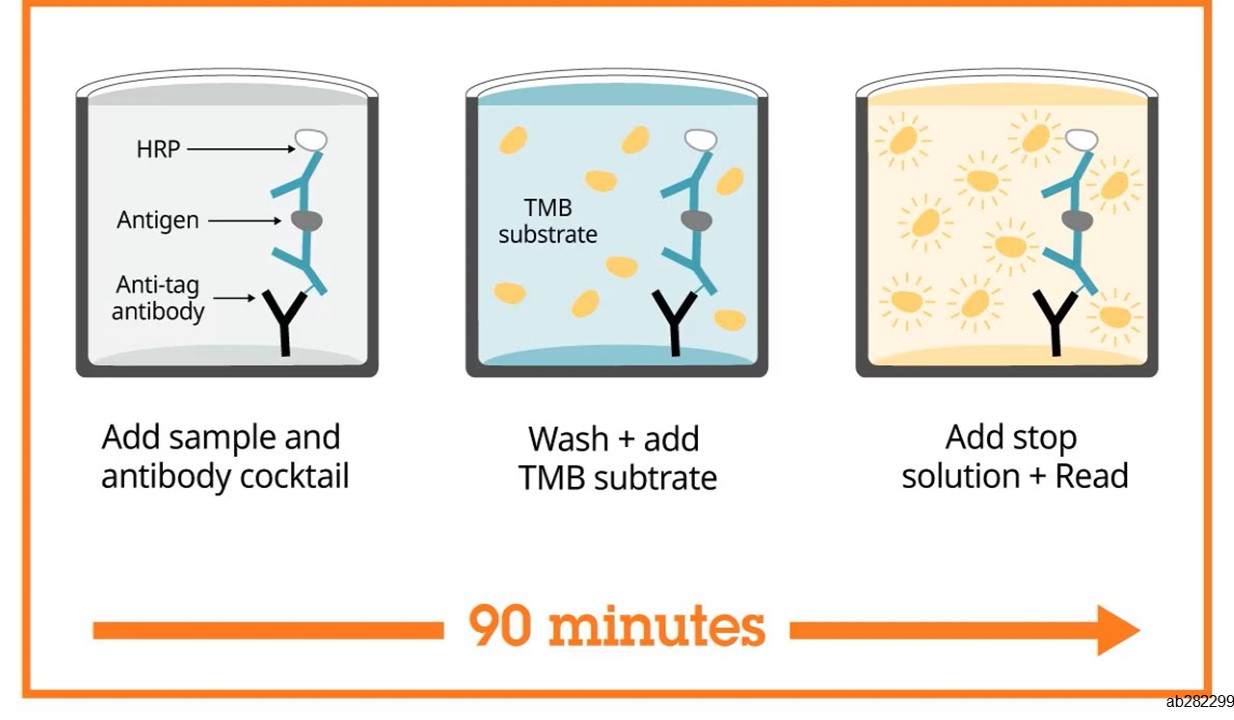
A goat anti-rabbit IgG antibody has been precoated onto 96-well plates. Standards or test samples are added to the wells, along with an alkaline phosphatase (AP) conjugated-Substance P antigen and a polyclonal rabbit antibody specific to Substance P. After incubation the excess reagents are washed away. pNpp substrate is added and after a short incubation the enzyme reaction is stopped and the yellow color generated is read at 405 nm. The intensity of the yellow coloration is inversely proportional to the amount of Substance P captured in the plate.

Substance P is a undecapeptide that displays a number of biological activities. The peptide was first discovered in 1931 by von Euler and Gaddum. They reported that extracts of equine brain and intestine contained a hypotensive and spasmogenic factor. The preparation, termed preparation P, was later found to be proteinaceous. The isolation and characterization of Substance P was carried out by Leeman's group in 1970. The structure is shown below.

Substance P: H-Arg-Pro-Lys-Pro-Gln-Gln-Phe-Phe-Gly-Leu-Met-NH2

Substance P is synthesized in the ribosomes as a larger protein and then enzymatically converted into the active peptide. The peptide is widely distributed in the peripheral and central nervous systems of vertebrates, where it is thought to act as a neurotransmitter. In the peripheral system, Substance P is localized in the primary sensory neurons and neurons intrinsic to the gastrointestinal tract.

Cross Reactivity

Compound % Cross Reactivity
Substance P 100
Substance P (4-11) >100
Substance P (7-11) >100
Substance P (3-11) 66
Physalaemin 50
Eledoisin <0.001
α-Neurokinin <0.001
β-Neurokinin <0.001
Somatostatin <0.001
Substance P (1-4) <0.001

回收率

[ { "sample": "Serum", "range": null, "average": "= 97.7" }, { "sample": "Urine", "range": null, "average": "= 105.8" }, { "sample": "Saliva", "range": null, "average": "= 108.3" }, { "sample": "Heparin Plasma", "range": null, "average": "= 109.3" }, { "sample": "Tissue Culture Media", "range": null, "average": "= 81" } ]

规格

{ "values": { "1x96Tests": { "sellingSize": "1 x 96 Tests", "publicAssetCode":"ab288318-1x96Tests", "assetComponentDetails": [ { "size":"1 x 5 mL", "name":"Stop Solution", "number":"AB288318-CMP04", "productcode":"" }, { "size":"1 x 20 mL", "name":"pNpp Substrate", "number":"AB288318-CMP03", "productcode":"" }, { "size":"1 x 27 mL", "name":"Assay Buffer", "number":"AB288318-CMP01", "productcode":"" }, { "size":"1 x 500 µL", "name":"Substance P Standard", "number":"AB288318-CMP07", "productcode":"" }, { "size":"1 x 1 Unit", "name":"Plate Sealer", "number":"AB288318-CMP02", "productcode":"" }, { "size":"1 x 1 Unit", "name":"Goat anti-rabbit IgG Microplate (12 x 8 wells)", "number":"AB288318-CMP09", "productcode":"" }, { "size":"1 x 27 mL", "name":"20X Wash Buffer Concentrate", "number":"AB288318-CMP08", "productcode":"" }, { "size":"1 x 5 mL", "name":"Substance P Antibody", "number":"AB288318-CMP05", "productcode":"" }, { "size":"1 x 5 mL", "name":"Substance P Alkaline Phosphatase Conjugate", "number":"AB288318-CMP06", "productcode":"" } ] } } }

性能和储存信息

运输条件
Blue Ice
推荐的短期储存条件
Multi
推荐的长期储存条件
Multi
储存信息
Please refer to protocols

补充信息

This supplementary information is collated from multiple sources and compiled automatically.

Substance P also known as neurokinin 1 (NK1) receptor agonist is a neuropeptide with molecular mass approximately 1.3 kDa. Substance P exists mainly in the central nervous system and peripheral nervous system. This peptide performs mechanical roles by interacting with its receptor the NK1 receptor which is widespread in neurons and various tissues. It is important for processing pain signals and mood regulation. Substance P belongs to the family of tachykinins which are characterized by the common C-terminal sequence.
Biological function summary

This peptide acts as a neurotransmitter and neuromodulator in the body. Its functions are significant in the transmission of pain information into the central nervous system where it acts independently rather than being part of a larger protein complex. Additionally Substance P contributes to the regulation of inflammatory processes which impacts immune response. This peptide is not only important for pain perception but also participates in regulating emotional responses and stress.

Pathways

Substance P has a major role in the neurokinin signaling pathway. Within this pathway it interacts with other proteins such as calcitonin gene-related peptide (CGRP) enhancing its function in pain transmission and modulation. Additionally Substance P is part of the MAPK/ERK pathway where it influences cell proliferation and survival although its primary actions focus on signaling through the NK1 receptor.

Substance P is connected to conditions such as chronic pain and depression. By interacting with proteins like the NK1 receptor it is implicated in the sensation and perception of pain leading to an increased understanding of chronic pain mechanisms. Substance P also relates to inflammatory diseases with its involvement in pathways that influence inflammation and could serve as targets for therapeutic intervention in disorders like arthritis. Anti-substance therapeutics aim to modulate its effects to treat these conditions.

产品实验方案

靶点信息

Tachykinins are active peptides which excite neurons, evoke behavioral responses, are potent vasodilators and secretagogues, and contract (directly or indirectly) many smooth muscles.. Substance P. Is a ligand for TACR1, and triggers G protein-coupled receptor signaling via activation of phosphatidylinositol hydrolysis by phospholipase C. Substance P binding to TACR1 also triggers signaling via activation of adenylate cyclase activity which results in increased intracellular levels of cyclic AMP (cAMP) (By similarity). Is also a TACR3 agonist with low receptor affinity (PubMed : 37391393). Basic secretagogue neuropeptide released from the terminals of specific sensory nerves (PubMed : 30686732). Acts as a ligand for MRGPRX2 receptor in mast cells, initiating a signaling that mediates neurogenic inflammation and pain (PubMed : 30686732, PubMed : 34789875). Neurogenic inflammation includes mast cell activation, recruitment of immune cells and release of inflammatory mediators, such as cytokines and chemokines (By similarity). The inflammatory response can then activate or sensitize nociceptors, promoting pain (By similarity).. Neurokinin A. Is a ligand for TACR2, and triggers G protein-coupled receptor signaling via activation of G(q) and phosphatidylinositol hydrolysis by phospholipase C (PubMed : 35882833). Binding to TACR2 also triggers signaling via activation of adenylate cyclase activity which results in increased intracellular levels of cyclic AMP (cAMP).
See full target information TAC1

文献 (2)

Recent publications for all applications. Explore the full list and refine your search

Frontiers in molecular neuroscience 18:1583908 PubMed40453756

2025

Bidirectional substance P signaling between periodontal ligament fibroblasts and sensory neurons under mechanical stress.

Applications

Unspecified application

Species

Unspecified reactive species

Judit Symmank,Lara Löffler,Ulrike Schulze-Späte,Collin Jacobs

International journal of stem cells 16:269-280 PubMed37385635

2023

Peripheral Neuron-Organoid Interaction Induces Colonic Epithelial Differentiation via Non-Synaptic Substance P Secretion.

Applications

Unspecified application

Species

Unspecified reactive species

Young Hyun Che,In Young Choi,Chan Eui Song,Chulsoon Park,Seung Kwon Lim,Jeong Hee Kim,Su Haeng Sung,Jae Hoon Park,Sun Lee,Yong Jun Kim
View all publications
websiteProtocolBooklet
en

Abcam Product Promise

我们致力于为您的研究提供高质量的试剂,为您科研的每一步提供支持。若我们的产品未能达到预期性能,我们向您提供 Abcam Product Promise 保障。
详情请参阅我们的条款与条件。

Please note: All products are 'FOR RESEARCH USE ONLY. NOT FOR USE IN DIAGNOSTIC OR THERAPEUTIC PROCEDURES'.

For licensing inquiries, please contact partnerships@abcam.com