JavaScript is disabled in your browser. Please enable JavaScript to view this website.
AB279776

Phospho-eIF4E (S209) ELISA试剂盒

Phospho-eIF4E (S209) ELISA Kit

Be the first to review this product! Submit a review

|

(0 Publication)

Phospho-eIF4E (S209) ELISA Kit is a ELISA for the measurement of Phospho-eIF4E (S209) in Human in Cell/Tissue Extracts samples.

查看别名

EIF4EL1, EIF4F, EIF4E, Eukaryotic translation initiation factor 4E, eIF-4E, eIF4E, eIF-4F 25 kDa subunit, mRNA cap-binding protein
3 Images
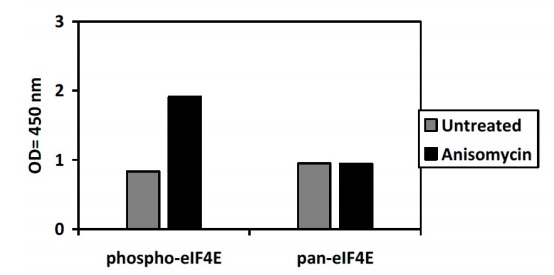
Sandwich ELISA - Phospho-eIF4E (S209) ELISA Kit (AB279776)
  • sELISA

Supplier Data

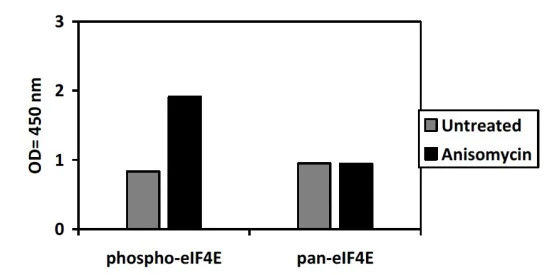
Sandwich ELISA - Phospho-eIF4E (S209) ELISA Kit (AB279776)

HeLa cells treated with/without Anisomycin. HeLa cells were untreated or treated with Anisomycin.
Sandwich ELISA - Phospho-eIF4E (S209) ELISA Kit (AB279776)
  • sELISA

Supplier Data

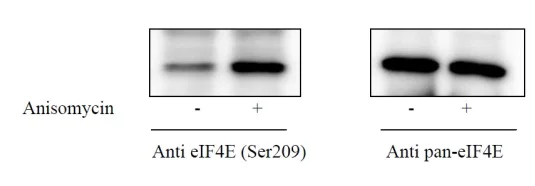
Sandwich ELISA - Phospho-eIF4E (S209) ELISA Kit (AB279776)

HeLa cells treated with/without Anisomycin. HeLa cells were untreated or treated with Anisomycin.
Sandwich ELISA - Phospho-eIF4E (S209) ELISA Kit (AB279776)
  • sELISA

Supplier Data

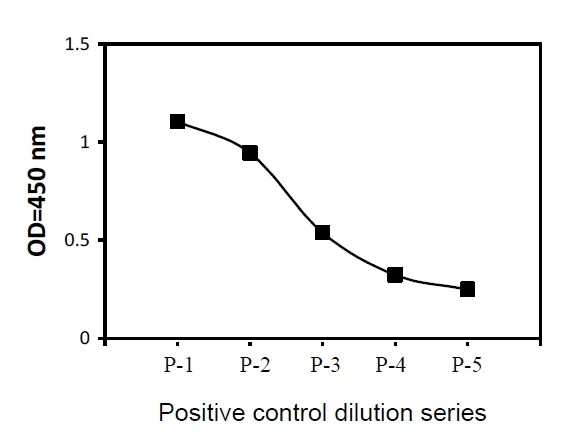
Sandwich ELISA - Phospho-eIF4E (S209) ELISA Kit (AB279776)

Positive Control.

HeLa cells were treated with Anisomycin.

Solubilize cells at 4 x 10⁷ cells/ml in Cell Lysate Buffer.

Serial dilutions of lysates were analyzed in this ELISA.

关键信息

检测方法

Colorimetric

样品类型

Cell Lysate

反应种属

Human

Semi-Quantitative
检测平台

Pre-coated microplate (12 x 8 well strips)

反应性数据

{ "title": "Reactivity Data", "filters": { "stats": ["", "Reactivity", "Dilution Info", "Notes"] }, "values": { "ELISA": { "reactivity":"TESTED_AND_REACTS", "dilution-info":"", "notes":"<p></p>" } } }

产品详情

Phospho-eIF4E (S209) ELISA Kit (ab279776) is a very rapid, convenient, and sensitive assay kit that can monitor the activation or function of important biological pathways in human cell lysates. By determining phosphorylated eIF4E protein in your experimental model system, you can verify pathway activation in your cell lysates. You can simultaneously measure numerous different cell lysates without spending excess time and effort in performing a Western Blotting analysis.

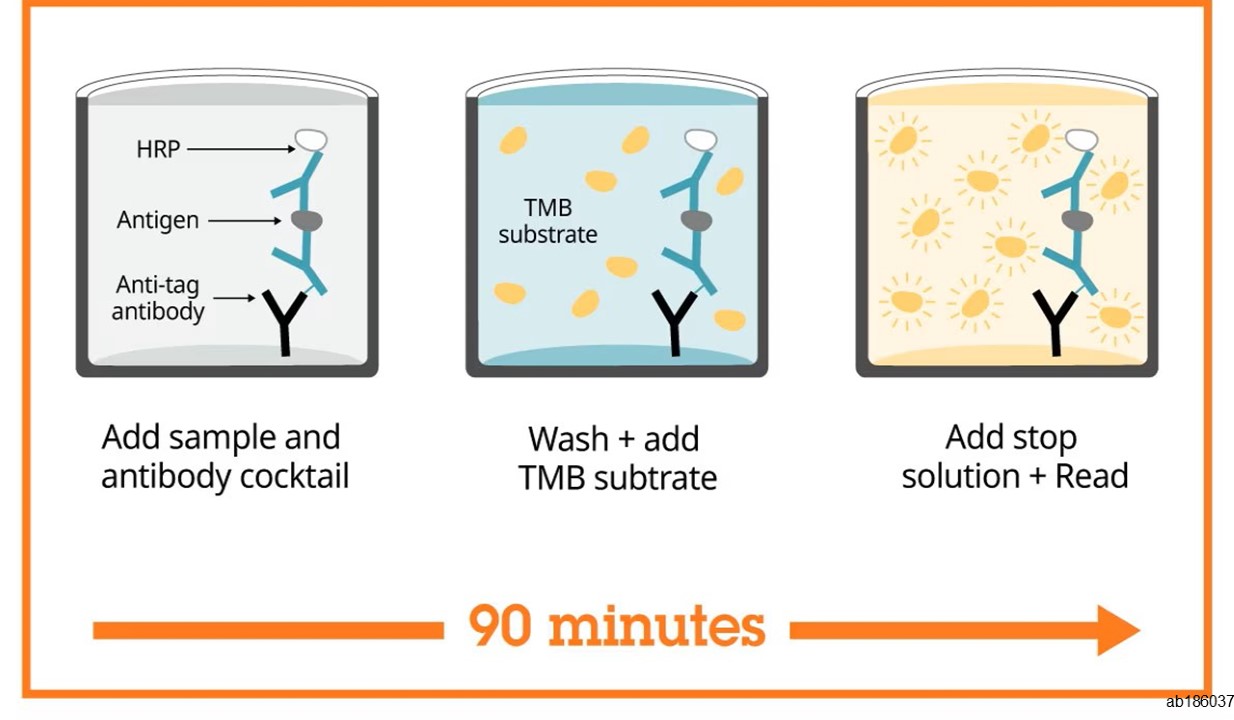
This Sandwich ELISA kit is an in vitro enzyme-linked immunosorbent assay for the measurement of human phospho-eIF4E. An anti-pan eIF4E antibody has been coated onto a 96-well plate. Samples are pipetted into the wells and eIF4E present in a sample is bound to the wells by the immobilized antibody. The wells are washed and rabbit anti-phospho-eIF4E (S209) antibody is used to detect phosphorylated eIF4E. After washing away unbound antibody, HRP conjugated anti-rabbit IgG is pipetted into the wells. The wells are again washed, a TMB substrate solution is added to the wells and color develops in proportion to the amount of eIF4E (S209) bound. The Stop Solution changes the color from blue to yellow, and the intensity of the color is measured at 450 nm.

REACH authorisation
Abcam has not and does not intend to apply for the REACH Authorisation of customers' uses of products that contain European Authorisation list (Annex XIV) substances.
It is the responsibility of our customers to check the necessity of application of REACH Authorisation, and any other relevant authorisations, for their intended uses.

规格

{ "values": { "1x96Tests": { "sellingSize": "1 x 96 Tests", "publicAssetCode":"ab279776-1x96Tests", "assetComponentDetails": [ { "size":"1 x 1 Vial", "name":"Positive Control - treated HeLa cell lysate", "number":"AB279776-CMP02", "productcode":"" }, { "size":"1 x 1 Unit", "name":"Pan-eIF4E Coated Microplate", "number":"AB279776-CMP03", "productcode":"" }, { "size":"1 x 12 mL", "name":"TMB One-Step Substrate Reagent", "number":"AB279776-CMP08", "productcode":"" }, { "size":"1 x 25 mL", "name":"20X Wash Buffer", "number":"AB279776-CMP04", "productcode":"" }, { "size":"1 x 15 mL", "name":"5X Assay Diluent", "number":"AB279776-CMP06", "productcode":"" }, { "size":"1 x 5 mL", "name":"2X Cell lysate buffer", "number":"AB279776-CMP09", "productcode":"" }, { "size":"1 x 8 mL", "name":"Stop Solution", "number":"AB279776-CMP07", "productcode":"" }, { "size":"1 x 25 µL", "name":"HRP-conjugated anti-rabbit IgG concentrate (1000X)", "number":"AB279776-CMP01", "productcode":"" }, { "size":"2 x 1 Vial", "name":"Rabbit anti-phospho-eIF4E (S209)-antibody", "number":"AB279776-CMP05", "productcode":"" } ] } } }

性能和储存信息

运输条件
Blue Ice
推荐的短期储存条件
-20°C
推荐的长期储存条件
-20°C
储存信息
-20°C

补充信息

This supplementary information is collated from multiple sources and compiled automatically.

The eIF4E protein also known as the eukaryotic translation initiation factor 4E functions mainly in the initiation phase of mRNA translation. It plays a role by binding to the 7-methylguanylate cap structure at the 5’ end of mRNA facilitating ribosome assembly on mRNA. The molecular weight of eIF4E is approximately 25 kDa and it is ubiquitously expressed in various tissues across eukaryotic organisms. Additionally phosphorylation of eIF4E affects its activity and is an important post-translational modification.
Biological function summary

EIF4E regulates gene expression at the translational level and is a part of the eIF4F complex which also includes eIF4A and eIF4G. This complex is essential for the recruitment of ribosomes to the mRNA impacting the rate of protein synthesis. Changes in eIF4E levels can alter the translational efficiency of specific mRNAs thereby influencing cellular growth and proliferation.

Pathways

EIF4E directly involves in the mTOR signaling pathway which regulates cell growth proliferation and survival. Within this pathway eIF4E interacts with proteins such as 4EBP1 which binds to eIF4E and inhibits its function in the absence of phosphorylation by mTOR. This interaction illustrates the control mechanism of protein synthesis under different cellular conditions connecting it to various signaling cascades.

EIF4E has been linked to cancer and neurodegenerative conditions. In cancer overexpression of eIF4E leads to increased translation of oncogenes facilitating tumorigenesis. The mTOR pathway proteins like mTOR and 4EBP1 are often dysregulated in these cases. Conversely its role in neurological disorders involves the aberrant regulation of synaptic proteins like PSD95 impacting neuronal communication and function.

产品实验方案

靶点信息

Acts in the cytoplasm to initiate and regulate protein synthesis and is required in the nucleus for export of a subset of mRNAs from the nucleus to the cytoplasm which promotes processes such as RNA capping, processing and splicing (PubMed : 11606200, PubMed : 22578813, PubMed : 22684010, PubMed : 24335285, PubMed : 29987188). Component of the protein complex eIF4F, which is involved in the recognition of the mRNA cap, ATP-dependent unwinding of 5'-terminal secondary structure and recruitment of mRNA to the ribosome (By similarity). This protein recognizes and binds the 7-methylguanosine (m7G)-containing mRNA cap during an early step in the initiation of protein synthesis and facilitates ribosome binding by inducing the unwinding of the mRNAs secondary structures (PubMed : 16271312, PubMed : 22578813). Together with EIF4G1, antagonizes the scanning promoted by EIF1-EIF4G1 and is required for TISU translation, a process where the TISU element recognition makes scanning unnecessary (PubMed : 29987188). In addition to its role in translation initiation, also acts as a regulator of translation and stability in the cytoplasm (PubMed : 24335285). Component of the CYFIP1-EIF4E-FMR1 complex which binds to the mRNA cap and mediates translational repression : in the complex, EIF4E mediates the binding to the mRNA cap (By similarity). Component of a multiprotein complex that sequesters and represses translation of proneurogenic factors during neurogenesis (By similarity). In P-bodies, component of a complex that mediates the storage of translationally inactive mRNAs in the cytoplasm and prevents their degradation (PubMed : 24335285). May play an important role in spermatogenesis through translational regulation of stage-specific mRNAs during germ cell development (By similarity). As well as its roles in translation, also involved in mRNA nucleocytoplasmic transport (By similarity). Its role in mRNA export from the nucleus to the cytoplasm relies on its ability to bind the m7G cap of RNAs and on the presence of the 50-nucleotide EIF4E sensitivity element (4ESE) in the 3'UTR of sensitive transcripts (By similarity). Interaction with the 4ESE is mediated by LRPPRC which binds simultaneously to both EIF4E and the 4ESE, thereby acting as a platform for assembly for the RNA export complex (By similarity). EIF4E-dependent mRNA export is independent of ongoing protein or RNA synthesis and is also NFX1-independent but is XPO1-dependent with LRPPRC interacting with XPO1 to form an EIF4E-dependent mRNA export complex (By similarity). Alters the composition of the cytoplasmic face of the nuclear pore to promote RNA export by reducing RANBP2 expression, relocalizing nucleoporin NUP214 and increasing expression of RANBP1 and RNA export factors DDX19 and GLE1 (By similarity). Promotes the nuclear export of cyclin CCND1 mRNA (By similarity). Promotes the nuclear export of NOS2/iNOS mRNA (PubMed : 23471078). Promotes the nuclear export of MDM2 mRNA (PubMed : 22684010). Promotes the export of additional mRNAs, including others involved in the cell cycle (By similarity). In the nucleus, binds to capped splice factor-encoding mRNAs and stimulates their nuclear export to enhance splice factor production by increasing their cytoplasmic availability to the translation machinery (By similarity). May also regulate splicing through interaction with the spliceosome in an RNA and m7G cap-dependent manner (By similarity). Also binds to some pre-mRNAs and may play a role in their recruitment to the spliceosome (By similarity). Promotes steady-state capping of a subset of coding and non-coding RNAs by mediating nuclear export of capping machinery mRNAs including RNMT, RNGTT and RAMAC to enhance their translation (By similarity). Stimulates mRNA 3'-end processing by promoting the expression of several core cleavage complex factors required for mRNA cleavage and polyadenylation, and may also have a direct effect through its interaction with the CPSF3 cleavage enzyme (By similarity). Rescues cells from apoptosis by promoting activation of serine/threonine-protein kinase AKT1 through mRNA export of NBS1 which potentiates AKT1 phosphorylation and also through mRNA export of AKT1 effectors, allowing for increased production of these proteins (By similarity).
See full target information EIF4E pS209
websiteProtocolBooklet
en

Abcam Product Promise

我们致力于为您的研究提供高质量的试剂,为您科研的每一步提供支持。若我们的产品未能达到预期性能,我们向您提供 Abcam Product Promise 保障。
详情请参阅我们的条款与条件。

Please note: All products are 'FOR RESEARCH USE ONLY. NOT FOR USE IN DIAGNOSTIC OR THERAPEUTIC PROCEDURES'.

For licensing inquiries, please contact partnerships@abcam.com