JavaScript is disabled in your browser. Please enable JavaScript to view this website.
AB157718

小鼠IgE ELISA试剂盒

Mouse IgE ELISA Kit

2

(2 Reviews)

|

(31 Publications)

Mouse IgE ELISA Kit is a sandwich ELISA designed to quantify Mouse IgE with a sensitivity of 1.83 ng/mL.

- Colorimetric sandwich ELISA - 450 nm readout - works on any plate reader
- Wide dynamic range - quantifies 6.25 - 400 ng/mL
- Cited in over 20 publications

查看别名

Immunoglobulin heavy constant epsilon, Ig epsilon chain C region, IGHE
3 Images
Sandwich ELISA - Mouse IgE ELISA Kit (AB157718)
  • sELISA

Supplier Data

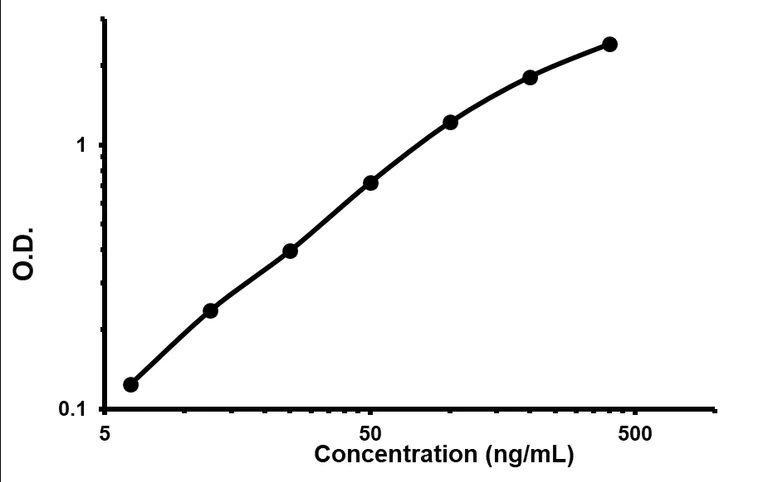
Sandwich ELISA - Mouse IgE ELISA Kit (AB157718)

Representative standard curve using ab157718.
Sandwich ELISA - Mouse IgE ELISA Kit (AB157718)
  • sELISA

Lab

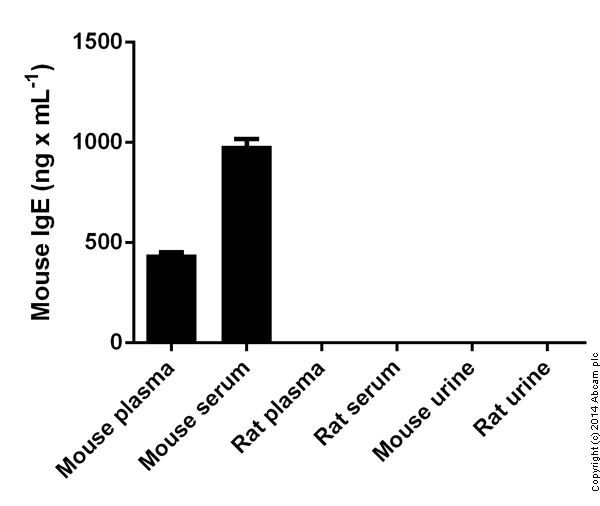
Sandwich ELISA - Mouse IgE ELISA Kit (AB157718)

Mouse IgE measured in biologicals showing quantity (ng) per mL of tested sample
Sandwich ELISA - Mouse IgE ELISA Kit (AB157718)
  • sELISA

Lab

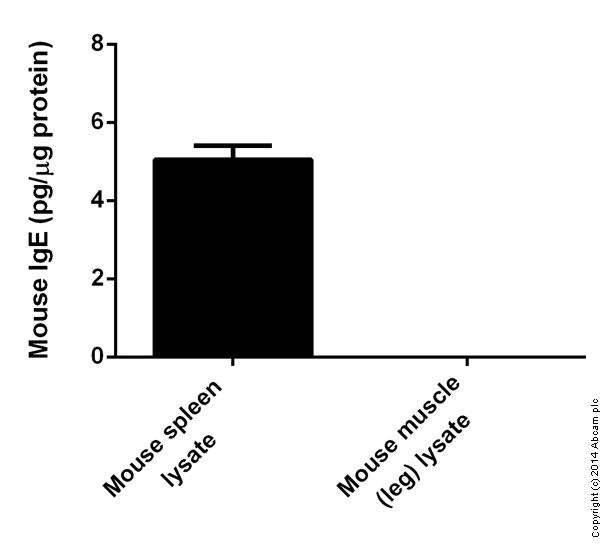
Sandwich ELISA - Mouse IgE ELISA Kit (AB157718)

Mouse IgE measured in tissue lysates showing quantity (pg) per microgram of protein

关键信息

检测方法

Colorimetric

样品类型

Plasma, Serum, Other biological fluids

反应种属

Mouse

检测类型

Sandwich

Quantitative
灵敏度

= 1.83 ng/mL

范围

6.25 - 400 ng/mL

检测平台

Microplate

反应性数据

{ "title": "Reactivity Data", "filters": { "stats": ["", "Reactivity", "Dilution Info", "Notes"] }, "values": { "sELISA": { "reactivity":"TESTED_AND_REACTS", "dilution-info":"", "notes":"<p></p>" } } }

产品详情

Mouse IgE ELISA Kit ab157718 is a sandwich ELISA to measure Mouse IgE in serum, plasma, other biological fluids with a sensitivity of 1.83 ng/ml.

How the assay works

In this assay the IgE present in samples reacts with the anti-IgE antibodies which have been adsorbed to the surface of polystyrene microtitre wells. After the removal of unbound proteins by washing, anti-IgE antibodies conjugated with horseradish peroxidase (HRP), are added. These enzyme-labeled antibodies form complexes with the previously bound IgE. Following another washing step, the enzyme bound to the immunosorbent is assayed by the addition of a chromogenic substrate, 3,3',5,5'-tetramethylbenzidine (TMB). The quantity of bound enzyme varies directly with the concentration of IgE in the sample tested; thus, the absorbance, at 450 nm, is a measure of the concentration of IgE in the test sample. The quantity of IgE in the test sample can be interpolated from the standard curve constructed from the standards, and corrected for sample dilution.

Assay Specificity

Our ELISA kits are rigorously validated to ensure the highest level of consistency and reproducibility. Please check the protocol booklet for more details

Mouse IgE ELISA Kit ab157718 protocol summary

1. Add standard or sample to each well used. Incubate at room temperature.
2. Aspirate and wash each well. Add prepared HRP labeled secondary detector antibody. Incubate at room temperature
3. Aspirate and wash each well.
4. Add Chromogen Substrate Solution to each well.
5. Immediately begin recording the color development

精确度

[ { "reproducibilityType": "Inter", "sample": "Overall", "replicates": 0, "mean": null, "standardDeviation": null, "coefficientOfVariability": "< 10" }, { "reproducibilityType": "Intra", "sample": "Overall", "replicates": 0, "mean": null, "standardDeviation": null, "coefficientOfVariability": "< 10" } ]

回收率

[ { "sample": "Serum", "range": null, "average": "> 85" } ]

规格

{ "values": { "1x96Tests": { "sellingSize": "1 x 96 Tests", "publicAssetCode":"ab157718-1x96Tests", "assetComponentDetails": [ { "size":"1 x 50 mL", "name":"5X Diluent Concentrate", "number":"AB157718-CMP07", "productcode":"" }, { "size":"1 x 12 mL", "name":"Chromogen Substrate Solution", "number":"AB157718-CMP02", "productcode":"" }, { "size":"1 x 50 mL", "name":"20X Wash Buffer Concentrate", "number":"AB157718-CMP06", "productcode":"" }, { "size":"1 x 12 mL", "name":"Stop Solution", "number":"AB157718-CMP01", "productcode":"" }, { "size":"1 x 1 Unit", "name":"Mouse IgE ELISA Microplate", "number":"AB157718-CMP05", "productcode":"" }, { "size":"1 x 1 Vial", "name":"Mouse IgE Calibrator (Lyophilized)", "number":"AB157718-CMP04", "productcode":"" }, { "size":"1 x 150 µL", "name":"100X HRP-conjugated anti-mouse IgE antibody", "number":"AB157718-CMP03", "productcode":"" } ] } } }

性能和储存信息

运输条件
Blue Ice
推荐的短期储存条件
+4°C
推荐的长期储存条件
+4°C
储存信息
+4°C

补充信息

This supplementary information is collated from multiple sources and compiled automatically.

The IgE protein [also known as immunoglobulin E] is a type of antibody with a molecular mass of approximately 190 kDa. IgE is expressed primarily on the surface of mast cells and basophils. It plays a central role in the immune system by binding to allergens and triggering the release of inflammatory mediators from mast cells and basophils. IgE's high-affinity binding to its receptor FcεRI on these effector cells facilitates this process. IgE's activity is central to initiating immediate hypersensitivity reactions which are a part of the body's immune response.
Biological function summary

The IgE protein functions as a mediator in allergic reactions. It does not operate as part of a complex but directly interacts with allergens and the IgE-specific receptors on immune cells. IgE's role is important in defense against parasitic infections where it performs a protective function by promoting eosinophil activation and degranulation. This action helps the body to expel the parasites. In the absence of parasitic infection IgE's function translates into its role in allergic responses where it becomes responsible for the symptoms associated with allergic diseases.

Pathways

IgE is an important player in the immune response pathway. The protein interacts with allergy-related pathways such as the T helper 2 (Th2) pathway. IgE's role in this pathway involves cooperation with cytokines notably IL-4 and IL-13 which are produced by Th2 cells and promote IgE synthesis in B cells. Also IgE is linked to the FcεRI receptor signaling pathway that initiates the release of histamines and other mediators when IgE binds to an allergen leading to an allergic response.

IgE is closely linked to allergic conditions like asthma and allergic rhinitis. These conditions result from IgE-mediated inflammatory responses that affect the respiratory system. In asthma IgE antibodies play a role in airway inflammation and hyperreactivity by promoting the activation of multiple immune cells including eosinophils and mast cells. IgE's involvement in allergic rhinitis manifests through similar mechanisms with nasal inflammation and irritation. IgE's interaction with other proteins such as histamine-releasing factor exacerbates these conditions by increasing the release of histamine which intensifies the allergic symptoms.

产品实验方案

靶点信息

Constant region of immunoglobulin heavy chains. Immunoglobulins, also known as antibodies, are membrane-bound or secreted glycoproteins produced by B lymphocytes. In the recognition phase of humoral immunity, the membrane-bound immunoglobulins serve as receptors which, upon binding of a specific antigen, trigger the clonal expansion and differentiation of B lymphocytes into immunoglobulins-secreting plasma cells. Secreted immunoglobulins mediate the effector phase of humoral immunity, which results in the elimination of bound antigens. The antigen binding site is formed by the variable domain of one heavy chain, together with that of its associated light chain. Thus, each immunoglobulin has two antigen binding sites with remarkable affinity for a particular antigen. The variable domains are assembled by a process called V-(D)-J rearrangement and can then be subjected to somatic hypermutations which, after exposure to antigen and selection, allow affinity maturation for a particular antigen.
See full target information IGHE

文献 (31)

Recent publications for all applications. Explore the full list and refine your search

Chemical biology & drug design 105:e70142 PubMed40556500

2025

Apelin-13 Protects Against Airway Inflammation, Oxidative Stress, and Epithelial-Mesenchymal Transition in a Chronic Asthma Model.

Applications

Unspecified application

Species

Unspecified reactive species

Huifeng Sun,Ai Wang,Nan Shi

Journal of inflammation research 18:7907-7919 PubMed40546406

2025

Neural-Inflammation Mechanism of Spinal Palmitic Acid Promoting Atopic Dermatitis in Mice.

Applications

Unspecified application

Species

Unspecified reactive species

Jing Yang,Xiaoling Xue,Zhi Yang,Fei Hao,Bangtao Chen

Archives of dermatological research 317:535 PubMed40056166

2025

PeiTuQingXin formula alleviated atopic dermatitis symptoms via inhibiting TRADD/TRAF2/RIP1 complex mediated NF-κB signaling pathway activation.

Applications

Unspecified application

Species

Unspecified reactive species

Zixuan Cheng,Xin Ma,Feng Luo,Xiumei Mo,Junfeng Liu,Dachan Chen,Fenggen Yan

Frontiers in allergy 6:1533928 PubMed39927112

2025

Chitooligosaccharides suppress airway inflammation, fibrosis, and mucus hypersecretion in a house dust mite-induced allergy model.

Applications

Unspecified application

Species

Unspecified reactive species

Yun-Ho Kim,Chan-Ho Park,Ju Myung Kim,Yeo Cho Yoon

Allergologia et immunopathologia 52:29-35 PubMed39278848

2024

Isoorientin alleviates ovalbumin-stimulated allergic rhinitis in mice by restoring Th1/Th2 balance.

Applications

Unspecified application

Species

Unspecified reactive species

Jianyi Huang,Ran Ji,Xueshen Qian,Yuli Shen

Pharmaceutics 15: PubMed37765323

2023

(L.) Kuntze Extract Attenuates Ovalbumin-Induced Allergic Asthma by Regulating Airway Inflammation and Mucus Hypersecretion.

Applications

Unspecified application

Species

Unspecified reactive species

Sohi Kang,Hyun-Yong Kim,A Yeong Lee,Hyo Seon Kim,Jun Hong Park,Byeong Cheol Moon,Hyeon Hwa Nam,Sung-Wook Chae,Bokyung Jung,Changjong Moon,In Sik Shin,Joong Sun Kim,Yun-Soo Seo

Animals : an open access journal from MDPI 13: PubMed37444013

2023

Canine Mesenchymal-Stem-Cell-Derived Extracellular Vesicles Attenuate Atopic Dermatitis.

Applications

Unspecified application

Species

Unspecified reactive species

Byong Seung Cho,Sung-Bae Kim,Sokho Kim,Beomseok Rhee,Jungho Yoon,Jae Won Lee

Allergologia et immunopathologia 51:135-142 PubMed37169571

2023

Neferine alleviates ovalbumin-induced asthma via MAPK signaling pathways in mice.

Applications

Unspecified application

Species

Unspecified reactive species

Tonggang Zhu,Xue Xiao,Yufu Dong,Chengbo Yuan

Mediators of inflammation 2022:1267841 PubMed36345503

2022

Pyrroloquinoline Quinone Administration Alleviates Allergic Airway Inflammation in Mice by Regulating the JAK-STAT Signaling Pathway.

Applications

Unspecified application

Species

Unspecified reactive species

Zhihui Min,Jiebai Zhou,Ruolin Mao,Bo Cui,Yunfeng Cheng,Zhihong Chen

Annals of translational medicine 10:980 PubMed36267759

2022

Inhibitory effects of isoliquiritin on an atopic dermatitis model through the CD177/JAK2/STAT pathway and .

Applications

Unspecified application

Species

Unspecified reactive species

Qing Wu,Xiumei Mo,Ying Lin,Junfeng Liu,Siqi Ye,Yu Zhang,Xingxing Fan,Dacan Chen,Fenggen Yan
View all publications
websiteProtocolBooklet
en

Abcam Product Promise

我们致力于为您的研究提供高质量的试剂,为您科研的每一步提供支持。若我们的产品未能达到预期性能,我们向您提供 Abcam Product Promise 保障。
详情请参阅我们的条款与条件。

Please note: All products are 'FOR RESEARCH USE ONLY. NOT FOR USE IN DIAGNOSTIC OR THERAPEUTIC PROCEDURES'.

For licensing inquiries, please contact partnerships@abcam.com