人GYS1 (Glycogen synthase 1) knockout HeLa cell line
Human GYS1 (Glycogen synthase 1) knockout HeLa cell line
- Advanced Validation
- 了解详情
Be the first to review this product! Submit a review
|
(0 Publication)
GYS1 KO cell line available to order. KO validated by Western blot. Free of charge wild type control available. Knockout achieved by using CRISPR/Cas9, Homozygous: 1 bp deletion in exon 1. To order both knockout and wild-type control cells: select '2 x 1000000 Cells/vial'. To order only knockout cells: select '1000000 Cells/vial'.
查看别名
Glycogen synthase 1, GYS1, GYS
- WB
Lab
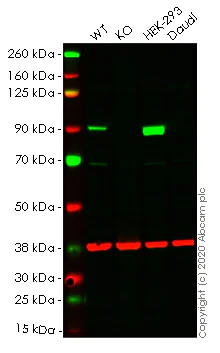
Western blot - Human GYS1 (Glycogen synthase 1) knockout HeLa cell line (AB265388)
ab40810 Recombinant Anti-Glycogen synthase 1/GYS1 antibody [EP817Y] was shown to specifically react with Glycogen synthase 1/GYS1 in HeLa wild-type cells (ab255928). Loss of signal was observed when knockout cell line ab265388 (knockout cell lysate ab257462) was used. Wild-type and Glycogen synthase 1/GYS1 knockout samples were subjected to SDS-PAGE. ab40810 and Anti-GAPDH antibody [6C5] - Loading Control (ab8245) were incubated overnight at 4° at 1 in 10000 dilution and 1 in 20000 dilution respectively. Blots were developed with Goat anti-Rabbit IgG H&L (IRDye® 800CW) preadsorbed (ab216773) and Goat anti-Mouse IgG H&L (IRDye® 680RD) preadsorbed (ab216776) secondary antibodies at 1 in 20000 dilution for 1 hour at room temperature before imaging.
All lanes:
Western blot - Anti-Glycogen synthase 1/GYS1 antibody [EP817Y] (<a href='/products/primary-antibodies/glycogen-synthase-1-gys1-antibody-ep817y-ab40810'>ab40810</a>) at 1/10000 dilution
Lane 1:
Wild-type HeLa lysate at 20 µg
Lane 2:
Glycogen synthase 1/GYS1 knockout HeLa lysate at 20 µg
Lane 2:
Western blot - Human GYS1 (Glycogen synthase 1) knockout HeLa cell line (ab265388)
Lane 3:
HEK-293 lysate at 20 µg
Lane 4:
Daudi lysate at 20 µg
Predicted band size: 84 kDa
Observed band size: 80 kDa
false

- Sanger seq
Unknown
Sanger Sequencing - Human GYS1 (Glycogen synthase 1) knockout HeLa cell line (AB265388)
Homozygous : 1 bp deletion in exon 1.
搭配使用产品
Primary Antibodies
AB40810
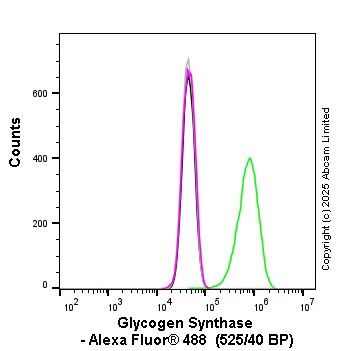
Anti-Glycogen synthase 1/GYS1 antibody [EP817Y]
20ul selling size|RabMAb|Recombinant|KO Validated
- 4
- 6
Primary Antibodies
AB187647
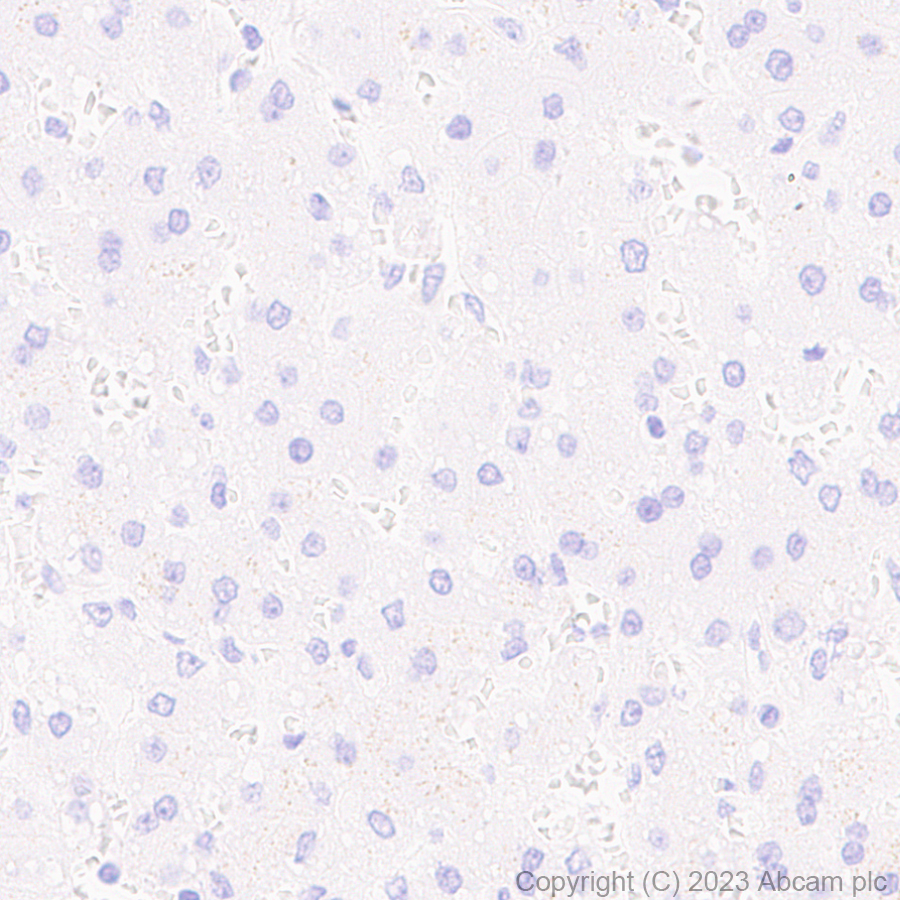
Anti-Cathepsin K antibody [EP9403]
20ul selling size|BOND RX™ Validated|RabMAb|Recombinant
- 5
- 1
Primary Antibodies
AB191406
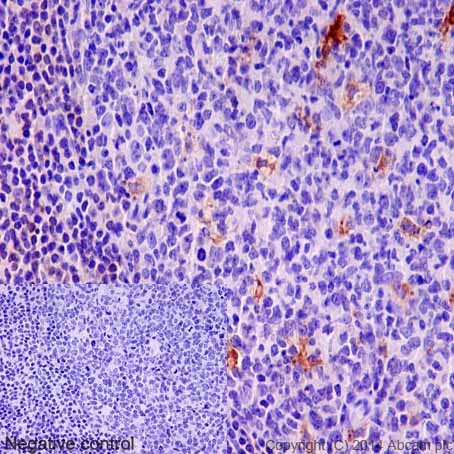
Anti-Tartrate Resistant Acid Phosphatase antibody [EPR15556]
20ul selling size|RabMAb|Recombinant
- 4
- 2

反应性数据
产品详情
We will provide viable cells that proliferate on revival.
This product is subject to limited use licenses from The Broad Institute and ERS Genomics Limited, and is developed with patented technology. For full details of the limited use licenses and relevant patents please refer to our limited use license and patent pages.
规格
性能和储存信息
基因名称
基因编辑类型
基因编辑方法
敲除验证
合子性
运输条件
推荐的短期储存条件
推荐的长期储存条件
补充信息
This supplementary information is collated from multiple sources and compiled automatically.
Biological function summary
This enzyme plays a critical role in the energy storage mechanism of muscle tissues. GYS1 functions as a part of the glycogen synthase complex interacting with various glycogen-associated proteins to modulate its activity. These interactions control the enzyme's affinity for its substrate and its susceptibility to regulatory signals like phosphorylation affecting glycogen synthesis efficiency. Through its activity GYS1 ensures a readily available reserve of glucose in muscle tissues for rapid energy production when required.
Pathways
Glycogen synthase 1 is a central component of the glycogen metabolism pathway. It acts alongside other enzymes such as glycogen phosphorylase which catalyzes glycogen breakdown. The balance between GYS1 and glycogen phosphorylase determines the rate of glycogen turnover within cells. GYS1 is further regulated by the insulin signaling pathway where insulin promotes glycogen synthesis by altering GYS1 activity alongside proteins like AKT influencing glucose homeostasis and energy management in tissues.
质量控制
STR 分析
CSF1PO, D13S317, D7S820, D5S818, TH01, D16S539, TPOX
细胞培养
生物安全等级
EU: 2 US: 2
贴壁/悬浮
Adherent
性别
Female
初始处理指南
Upon arrival, the vial should be stored in liquid nitrogen vapor phase and not at -80°C. Storage at -80°C may result in loss of viability. <p>1. Thaw the vial in 37°C water bath for approximately 1-2 minutes.<br>2. Transfer the cell suspension (0.8 mL) to a 15 mL/50 mL conical sterile polypropylene centrifuge tube containing 8.4 mL pre-warmed culture medium, wash vial with an additional 0.8 mL culture medium (total volume 10 mL) to collect remaining cells, and centrifuge at 201 x g (rcf) for 5 minutes at room temperature. 10 mL represents minimum recommended dilution. 20 mL represents maximum recommended dilution.<br>3. Resuspend the cell pellet in 5 mL pre-warmed culture medium and count using a haemocytometer or alternative cell counting method seed all remaining cells into a T25.<br>4. Incubate the culture at 37°C incubator with 5% CO<sub>2</sub>. Check the culture one day after revival and continue to check until 80% confluent. Media change can be given if needed.<br>5. Once confluent passage into an appropriate flask at a density of 2x10<sup>4</sup> cells/cm<sup>2</sup>. Seeding density is given as a guide only and should be scaled to align with individual lab schedules. Cultures should be monitored daily.</p>
传代培养指南
- All seeding densities should be based on cell counts gained by established methods.
- A guide seeding density of 2x10⁴ cells/cm2 is recommended.
- Cells should be passaged when they have achieved 80-90% confluence.
培养基
DMEM (High Glucose) + 10% FBS
低温储藏试剂
Cell Freezing Medium-DMSO Serum free media, contains 8.7% DMSO in MEM supplemented with methyl cellulose.
Abcam Product Promise
Please note: All products are 'FOR RESEARCH USE ONLY. NOT FOR USE IN DIAGNOSTIC OR THERAPEUTIC PROCEDURES'.
For licensing inquiries, please contact partnerships@abcam.com