JavaScript is disabled in your browser. Please enable JavaScript to view this website.
AB238540

N-epsilon-(Carboxyethyl) Lysine (CEL) Assay试剂盒

N-epsilon-(Carboxyethyl) Lysine (CEL) Assay Kit

Be the first to review this product! Submit a review

|

(0 Publication)
N-epsilon-(Carboxyethyl) Lysine (CEL) Assay Kit (ab238540) is designed for the rapid detection and quantitation of CEL protein adducts.
1 Images
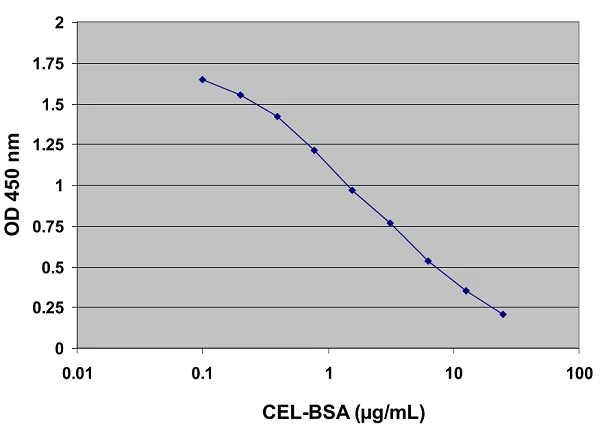
Competitive ELISA - N-epsilon-(Carboxyethyl) Lysine (CEL) Assay Kit (AB238540)
  • cELISA

Supplier Data

Competitive ELISA - N-epsilon-(Carboxyethyl) Lysine (CEL) Assay Kit (AB238540)

Example CEL-BSA ELISA Standard Curve.

Typical CEL ELISA results.

This data is for reference only and should not be used to interpret actual results.

关键信息

检测方法

Colorimetric

样品类型

Purified protein, Plasma, Serum, Cell Lysate

检测类型

Competitive

范围

0.1 - 25 µg/mL

检测平台

Microplate reader

产品详情

N-epsilon-(Carboxyethyl) Lysine (CEL) Assay Kit (ab238540) is designed for the rapid detection and quantitation of CEL protein adducts.

First, a CEL conjugate is coated on the ELISA plate. The unknown CEL protein samples or CEL-BSA standards are then added to the CEL conjugate preabsorbed plate. After a brief incubation the anti-CEL monoclonal antibody is added, followed by an HRP conjugated secondary antibody. The content of CEL protein adducts in unknown samples is determined by comparison with the pre-determined CEL-BSA standard curve. Despite the structure similarity between CEL and CML, the anti-CEL specific antibody in this kit will not cross react with CML protein adducts.

规格

{ "values": { "96Test": { "sellingSize": "96 Test", "publicAssetCode":"ab238540-96Test", "assetComponentDetails": [ { "size":"1 x 1 Unit", "name":"Protein Binding Strip Well Plate", "number":"AB238540-CMP03", "productcode":"" }, { "size":"1 x 12 mL", "name":"Stop Solution", "number":"AB238540-CMP09", "productcode":"" }, { "size":"1 x 50 mL", "name":"Assay Diluent", "number":"AB238540-CMP05", "productcode":"" }, { "size":"1 x 300 µL", "name":"100X Conjugate Diluent", "number":"AB238540-CMP01", "productcode":"" }, { "size":"1 x 100 mL", "name":"10X Wash Buffer", "number":"AB238540-CMP02", "productcode":"" }, { "size":"1 x 30 µL", "name":"CEL-BSA Standard", "number":"AB238540-CMP07", "productcode":"" }, { "size":"1 x 20 µL", "name":"CEL Conjugate", "number":"AB238540-CMP06", "productcode":"" }, { "size":"1 x 12 mL", "name":"Substrate Solution", "number":"AB238540-CMP10", "productcode":"" }, { "size":"1 x 20 µL", "name":"Secondary Antibody, HRP Conjugate (1000X)", "number":"AB238540-CMP08", "productcode":"" }, { "size":"1 x 10 µL", "name":"Anti-CEL Antibody (1000X)", "number":"AB238540-CMP04", "productcode":"" } ] } } }

性能和储存信息

运输条件
Blue Ice
推荐的短期储存条件
Multi
推荐的长期储存条件
Multi
储存信息
Please refer to protocols

补充信息

This supplementary information is collated from multiple sources and compiled automatically.

N-epsilon-(Carboxyethyl) Lysine (CEL) also known as carboxyethyl lysine stands as a specific type of advanced glycation end product (AGE). It forms through the non-enzymatic glycation of proteins particularly lysine residues. CEL exhibits a variable mass depending on its attached protein matrix. Researchers identify its presence significantly in long-lived proteins such as collagen and in dietary products like dairy and roasted meats. CEL forms through Maillard reaction pathways creating cross-links in proteins which affect their structure and function.
Biological function summary

The modification of proteins by CEL impacts cellular processes. CEL alters the function and lifespan of proteins disrupting homeostasis and contributing to altered cell signaling pathways. It is associated with the alteration of extracellular matrix proteins and redox-sensitive cytoplasmic proteins. CEL is not typically part of a specific complex but its presence can influence the assembly and function of protein complexes within cells. Its influence on protein modification underlies the aging process and other cellular dysfunctions.

Pathways

CEL plays a role in oxidative stress and inflammatory pathways. It associates with the receptor for AGE (RAGE) initiating signaling cascades that contribute to inflammation and oxidative stress. The AGE-RAGE axis represents a fundamental pathway where CEL engages in modifying cellular responses and protein expressions. Other related proteins include glyoxalase enzymes that detoxify reactive carbonyl species thereby potentially counteracting CEL formation and mitigating downstream effects.

CEL contributes to the pathogenesis of diabetes and atherosclerosis among others. In diabetes CEL accumulates in vascular tissues affecting hemodynamic function and promoting complications via RAGE-related pathways. In atherosclerosis CEL-modified proteins in arterial walls favor progression due to heightened inflammation and endothelial cell dysfunction. This interaction with RAGE and other AGE-related proteins assists in understanding CEL's role in disease progression and highlights potential therapeutic targets for managing these chronic conditions.

产品实验方案

websiteProtocolBooklet
en

Abcam Product Promise

我们致力于为您的研究提供高质量的试剂,为您科研的每一步提供支持。若我们的产品未能达到预期性能,我们向您提供 Abcam Product Promise 保障。
详情请参阅我们的条款与条件。

Please note: All products are 'FOR RESEARCH USE ONLY. NOT FOR USE IN DIAGNOSTIC OR THERAPEUTIC PROCEDURES'.

For licensing inquiries, please contact partnerships@abcam.com