JavaScript is disabled in your browser. Please enable JavaScript to view this website.
AB139451

MMP13抑制剂Screening Assay试剂盒(Fluorometric)

MMP13 Inhibitor Screening Assay Kit (Fluorometric)

Be the first to review this product! Submit a review

|

(1 Publication)

Abcam MMP13 Inhibitor Screening Assay Kit (Fluorometric) (ab139451) is a complete assay system designed to screen MMP13 inhibitors using a quenched fluorogenic peptide: MMP Fluorogenic Substrate Mca-Pro-Leu-Gly-Leu-Dpa-Ala-Arg-NH2 [Mca=(7-methoxycoumarin-4-yl)-acetyl; Dpa=N-3-(2,4-dinitrophenyl)-L-a-b-diaminopropionyl].

查看别名

Collagenase 3, Matrix metalloproteinase-13, MMP-13, MMP13
1 Images
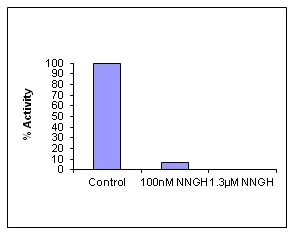
Functional Studies - MMP13 Inhibitor Screening Assay Kit (Fluorometric) (AB139451)
  • FuncS

Supplier Data

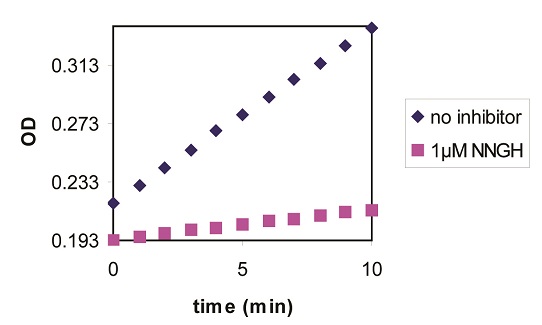
Functional Studies - MMP13 Inhibitor Screening Assay Kit (Fluorometric) (AB139451)

Inhibition of MMP13 by NNGH.

Example results.

关键信息

检测方法

Fluorescent

样品类型

Inhibitor compounds

检测类型

Enzyme activity

检测平台

Microplate reader

反应性数据

{ "title": "Reactivity Data", "filters": { "stats": ["", "Reactivity", "Dilution Info", "Notes"] }, "values": { "Enzyme activity assay": { "reactivity":"TESTED_AND_REACTS", "dilution-info":"", "notes":"<p></p>" } } }

产品详情

Abcam MMP13 Inhibitor Screening Assay Kit (Fluorometric) (ab139451) is a complete assay system designed to screen MMP13 inhibitors using a quenched fluorogenic peptide: MMP Fluorogenic Substrate Mca-Pro-Leu-Gly-Leu-Dpa-Ala-Arg-NH2 [Mca=(7-methoxycoumarin-4-yl)-acetyl; Dpa=N-3-(2,4-dinitrophenyl)-L-a-b-diaminopropionyl]. Mca fluorescence is quenched by the Dpa group until cleavage by MMPs at the Gly-Leu bond separates the two moieties. The assays are performed in a convenient 96-well microplate format.

This kit is useful to screen inhibitors of MMP13, a potential therapeutic target. The MMP inhibitor NNGH is also included as a prototypic control inhibitor.

规格

{ "values": { "1x96Tests": { "sellingSize": "1 x 96 Tests", "publicAssetCode":"ab139451-1x96Tests", "assetComponentDetails": [ { "size":"1 x 20 mL", "name":"Fluorometric Assay Buffer", "number":"AB139451-CMP05", "productcode":"" }, { "size":"1 x 1 Unit", "name":"96-well White Microplate 1/2 Volume", "number":"AB139451-CMP06", "productcode":"" }, { "size":"1 x 50 µL", "name":"MMP Calibration Standard", "number":"AB139451-CMP02", "productcode":"" }, { "size":"1 x 53 µL", "name":"MMP13 Enzyme (Human, Recombinant)", "number":"AB139451-CMP01", "productcode":"" }, { "size":"1 x 50 µL", "name":"MMP Inhibitor", "number":"AB139451-CMP04", "productcode":"" }, { "size":"1 x 200 µL", "name":"MMP Fluorogenic Substrate", "number":"AB139451-CMP03", "productcode":"" } ] } } }

性能和储存信息

运输条件
Dry Ice
推荐的短期储存条件
-80°C
推荐的长期储存条件
Multi
储存信息
Please refer to protocols

补充信息

This supplementary information is collated from multiple sources and compiled automatically.

Matrix metallopeptidase 13 (MMP-13) also called collagenase 3 is an enzyme with an approximate molecular mass of 54 kDa. It plays a significant role in the breakdown of extracellular matrix components particularly collagen. MMP-13 is expressed in several tissues including cartilage skin and bone. Its expression sees an increase during tissue remodeling and in pathological conditions. MMP-13 also participates in processes like wound healing and embryonic development making it a focal point for understanding tissue dynamics.
Biological function summary

Matrix metallopeptidase 13 contributes extensively to the degradation of collagen type II a major component of cartilage. As a zinc-dependent endopeptidase MMP-13 is part of the MMP family which facilitates the remodeling of the extracellular matrix. MMP-13 is involved in the proteolytic cascade working in conjunction with other MMPs and elastase to mediate tissue repair and turnover. It does not form complexes but acts in concert with other enzymes to execute its physiological functions effectively.

Pathways

Matrix metallopeptidase 13 significance is most noted in the cartilage degradation pathway. It interacts with other MMPs such as MMP-1 and MMP-9 to efficiently break down extracellular matrix components. These interactions highlight its role in the regulation of matrix metalloproteinase activity within the connective tissue degradation pathway. These pathways are key during normal connective tissue remodeling and in pathological processes illustrating the essential roles of MMPs in maintaining tissue homeostasis.

Matrix metallopeptidase 13 has strong associations with osteoarthritis and rheumatoid arthritis. It contributes to cartilage destruction intensifying the progression of these disorders due to its potent collagenolytic activity. Other proteins like MMP-9 and MMP-14 are also involved in these processes potentially amplifying tissue damage in affected joints. Understanding how MMP-13 and related proteins drive these diseases offers potential therapeutic targets for slowing disease progression and enhancing joint health.

产品实验方案

靶点信息

Plays a role in the degradation of extracellular matrix proteins including fibrillar collagen, fibronectin, TNC and ACAN. Cleaves triple helical collagens, including type I, type II and type III collagen, but has the highest activity with soluble type II collagen. Can also degrade collagen type IV, type XIV and type X. May also function by activating or degrading key regulatory proteins, such as TGFB1 and CCN2. Plays a role in wound healing, tissue remodeling, cartilage degradation, bone development, bone mineralization and ossification. Required for normal embryonic bone development and ossification. Plays a role in the healing of bone fractures via endochondral ossification. Plays a role in wound healing, probably by a mechanism that involves proteolytic activation of TGFB1 and degradation of CCN2. Plays a role in keratinocyte migration during wound healing. May play a role in cell migration and in tumor cell invasion.
See full target information MMP13

文献 (1)

Recent publications for all applications. Explore the full list and refine your search

International journal of molecular sciences 24: PubMed37108137

2023

Carborane-Containing Hydroxamate MMP Ligands for the Treatment of Tumors Using Boron Neutron Capture Therapy (BNCT): Efficacy without Tumor Cell Entry.

Applications

Unspecified application

Species

Unspecified reactive species

Sebastian Flieger,Mao Takagaki,Natsuko Kondo,Marlon R Lutz,Yash Gupta,Hiroki Ueda,Yoshinori Sakurai,Graham Moran,Prakasha Kempaiah,Narayan Hosmane,Minoru Suzuki,Daniel P Becker
View all publications
websiteProtocolBooklet
en

Abcam Product Promise

我们致力于为您的研究提供高质量的试剂,为您科研的每一步提供支持。若我们的产品未能达到预期性能,我们向您提供 Abcam Product Promise 保障。
详情请参阅我们的条款与条件。

Please note: All products are 'FOR RESEARCH USE ONLY. NOT FOR USE IN DIAGNOSTIC OR THERAPEUTIC PROCEDURES'.

For licensing inquiries, please contact partnerships@abcam.com