JavaScript is disabled in your browser. Please enable JavaScript to view this website.
AB238539

AGE (Advanced Glycation End) Assay试剂盒

AGE (Advanced Glycation End) Assay Kit

1

(1 Review)

|

(12 Publications)

AGE (Advanced Glycation End Products) Assay Kit (ab238539) is designed for the rapid detection and quantitation of advanced glycation end product protein adducts.

查看别名

AGEs, Advanced glycation end products
2 Images
Competitive ELISA - AGE (Advanced Glycation End) Assay Kit (AB238539)
  • cELISA

Supplier Data

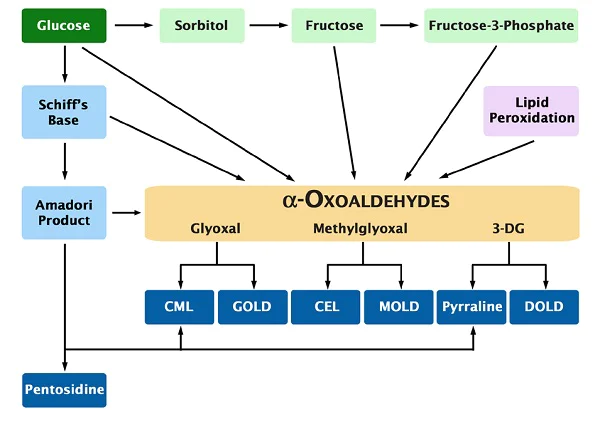
Competitive ELISA - AGE (Advanced Glycation End) Assay Kit (AB238539)

Advanced Glycation End Product Formation Pathways.

CML = N-epsilon-(carboxymethyl)lysine.

GOLD = glyoxal-derived lysine dimer.

CEL = N-epsilon-(1-carboxyethyl)lysine.

MOLD = methylglyoxal-derived lysine dimer.

DOLD = 3-deoxyglucosone-derived lysine dimer.

3-DG = 3-deoxyglucosone.
Competitive ELISA - AGE (Advanced Glycation End) Assay Kit (AB238539)
  • cELISA

Supplier Data

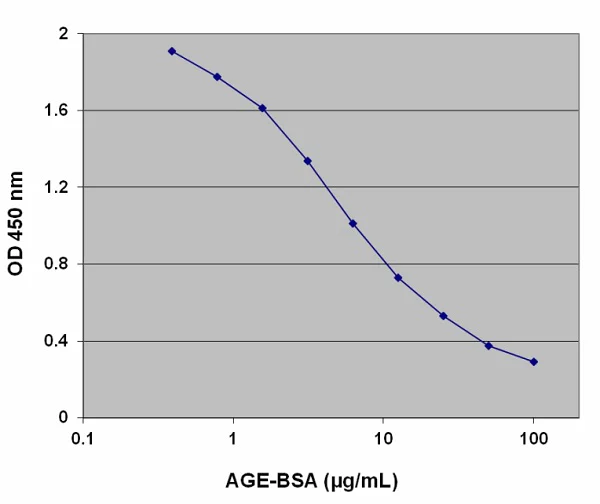
Competitive ELISA - AGE (Advanced Glycation End) Assay Kit (AB238539)

Example AGE-BSA Competitive ELISA Standard Curve.

Typical AGE Competitive ELISA results.

This data is for reference only and should not be used to interpret actual results.

关键信息

检测方法

Colorimetric

样品类型

Purified protein, Tissue Lysate, Plasma, Serum, Cell Lysate

检测类型

Competitive

灵敏度

= 0.5 µg/mL

范围

0.36 - 100 µg/mL

检测平台

Microplate reader

产品详情

AGE (Advanced Glycation End Products) Assay Kit (ab238539) is designed for the rapid detection and quantitation of advanced glycation end product protein adducts.

Advanced Glycation End Products (AGE) are formed during the Maillard reaction where reducing carbohydrates react with lysine side chains and N-terminal amino groups of various macromolecules, particularly proteins. The advanced glycation end products can adversely affect the fuction of these macromolecules. One of the most prevalent advanced glycation end products, N-epsilon-(Carboxymethyl) Lysine, has been implicated in oxidative stress and vascular damage. The quantity of AGE adduct in protein samples is determined by comparing its OD with that of a known AGE-BSA standard curve.

规格

{ "values": { "96Test": { "sellingSize": "96 Test", "publicAssetCode":"ab238539-96Test", "assetComponentDetails": [ { "size":"1 x 50 mL", "name":"Assay Diluent", "number":"AB238539-CMP07", "productcode":"" }, { "size":"1 x 1 Unit", "name":"Protein Binding Strip Well Plate", "number":"AB238539-CMP03", "productcode":"" }, { "size":"1 x 100 mL", "name":"10X Wash Buffer", "number":"AB238539-CMP02", "productcode":"" }, { "size":"1 x 300 µL", "name":"100X Conjugate Diluent", "number":"AB238539-CMP01", "productcode":"" }, { "size":"1 x 12 mL", "name":"Stop Solution", "number":"AB238539-CMP09", "productcode":"" }, { "size":"1 x 125 µL", "name":"AGE-BSA Standard", "number":"AB238539-CMP05", "productcode":"" }, { "size":"1 x 50 µL", "name":"AGE Conjugate", "number":"AB238539-CMP04", "productcode":"" }, { "size":"1 x 12 mL", "name":"Substrate Solution", "number":"AB238539-CMP10", "productcode":"" }, { "size":"1 x 20 µL", "name":"Secondary Antibody, HRP Conjugate (1000X)", "number":"AB238539-CMP08", "productcode":"" }, { "size":"1 x 10 µL", "name":"Anti-AGE Antibody (1000X)", "number":"AB238539-CMP06", "productcode":"" } ] } } }

性能和储存信息

运输条件
Blue Ice
推荐的短期储存条件
Multi
推荐的长期储存条件
Multi
储存信息
Please refer to protocols

补充信息

This supplementary information is collated from multiple sources and compiled automatically.

Advanced Glycation End-products (AGEs) are highly reactive compounds formed when reducing sugars non-enzymatically bind to proteins lipids or nucleic acids. They are often referred to as AGE products or AGE-BSA when in the form of bovine serum albumin (BSA). The molecular weight of AGE compounds can vary significantly due to the diversity of glycation products. AGEs express in various tissues but accumulate more in aging tissues and in certain pathological states. Detection of AGE products often utilizes AGE ELISA assays or fluorescence-based methods to measure AGE-BSA.
Biological function summary

AGE compounds affect cellular and tissue functions by altering structural proteins and increasing oxidative stress. While not a component of a specific complex AGEs catalyze cross-linking of proteins like collagen impacting tissue elasticity. The binding of AGEs to receptors such as RAGE (Receptor for Advanced Glycation End-products) triggers inflammatory pathways and oxidative stress. This interaction fuels the damaging effects of AGEs in biological systems which are assayed through AGE assays.

Pathways

AGE compounds influence several critical biological pathways particularly the NF-kB and MAPK pathways. These pathways mediate inflammation and cellular stress responses. The interaction with RAGE also affects signaling with related proteins like S100/calgranulins which further activate pro-inflammatory responses. The alteration of these pathways by AGE compounds highlights their significance in cellular dysfunction and age-related conditions.

AGE compounds play significant roles in the progression of diabetes and cardiovascular disease. In diabetes AGEs contribute to complications by modifying vascular structure and function where they link with proteins such as HbA1c in glycation. In cardiovascular disease AGE accumulation in vascular tissues enhances vascular stiffness and atherosclerotic lesion formation. The AGE-RAGE interaction perpetuates chronic inflammation further exacerbating these conditions.

产品实验方案

文献 (12)

Recent publications for all applications. Explore the full list and refine your search

Molecular medicine (Cambridge, Mass.) 31:15 PubMed39827347

2025

D-mannose promotes diabetic wound healing through inhibiting advanced glycation end products formation in keratinocytes.

Applications

Unspecified application

Species

Unspecified reactive species

Jialiang Luo,Tianxing Wu,Jing Zhang,Zhicheng Liang,Weijie Shao,Di Wang,Lei Li,Daming Zuo,Jia Zhou

Current research in food science 9:100827 PubMed39281341

2024

Sprouting facilitates the antiglycative effect of black soybean ( (L.) Merr.) by promoting the accumulation of isoflavones.

Applications

Unspecified application

Species

Unspecified reactive species

Qian Zhou,Yuxuan Chen,Lifang Peng,Jun Wu,Wen Hao,Mingfu Wang

Journal of translational medicine 22:643 PubMed38982516

2024

METTL3-mediated NDUFB5 m6A modification promotes cell migration and mitochondrial respiration to promote the wound healing of diabetic foot ulcer.

Applications

Unspecified application

Species

Unspecified reactive species

Tao Wang,Xu Li,Yue Tao,Xiaojun Wang,Limeng Li,Jianjun Liu

Cellular & molecular immunology 21:332-348 PubMed38228746

2024

Tissue-resident macrophages exacerbate lung injury after remote sterile damage.

Applications

Unspecified application

Species

Unspecified reactive species

Hanhui Zhong,Jingjing Ji,Jinling Zhuang,Ziying Xiong,Pengyun Xie,Xiaolei Liu,Jundi Zheng,Wangli Tian,Xiaoyang Hong,Jing Tang

Journal of biochemical and molecular toxicology 38:e23515 PubMed37632267

2023

Advanced glycation end products induce nucleus pulposus cell apoptosis by upregulating TXNIP via inhibiting glycolysis pathway in intervertebral disc degeneration.

Applications

Unspecified application

Species

Unspecified reactive species

Fei Chen,Xiaoping Sheng,Haobo Sun,Qunfeng Guo,Haibin Wang,Lecheng Wu,Bin Ni,Jun Yang

Biomolecules 13: PubMed37371535

2023

Emergent Inflammatory Markers and Echocardiographic Indices in Patients with Bronchial Asthma.

Applications

Unspecified application

Species

Unspecified reactive species

Nikolaos A Gkavogiannakis,James N Tsoporis,Ioannis-Alexandros Drosatos,George Tsirebolos,Shehla Izhar,Eleftherios Sakadakis,Andreas S Triantafyllis,Thomas G Parker,Lampros A Kalogiros,Howard Leong-Poi,Loukianos S Rallidis,Ioannis Rizos

Diabetology & metabolic syndrome 14:99 PubMed35841066

2022

MiR-574-3p inhibits glucose toxicity-induced pancreatic β-cell dysfunction by suppressing PRMT1.

Applications

Unspecified application

Species

Unspecified reactive species

Lixia Lv,Xiumin Wang,Jinhua Shen,Ying Cao,Qin Zhang

BMC oral health 22:206 PubMed35614406

2022

Increased expression of advanced glycation endproducts in the gingival crevicular fluid compromises periodontal status in cigarette-smokers and waterpipe users.

Applications

Unspecified application

Species

Unspecified reactive species

Dena Ali,Fatemah AlAhmari,Toshinari Mikami,Jagan Kumar Baskaradoss

Molecular medicine reports 25: PubMed35211757

2022

Advanced glycation end products promote osteoporosis by inducing ferroptosis in osteoblasts.

Applications

Unspecified application

Species

Unspecified reactive species

Weiwei Ge,Jian Jie,Jie Yao,Wei Li,Yahui Cheng,Wenjuan Lu

Biomedical reports 16:28 PubMed35251615

2022

Serum advanced glycation end-products and αB-crystallin in diabetic retinopathy patients.

Applications

Unspecified application

Species

Unspecified reactive species

Taku Yamamoto,Satoru Kase,Miyuki Murata,Susumu Ishida
View all publications
websiteProtocolBooklet
en

Abcam Product Promise

我们致力于为您的研究提供高质量的试剂,为您科研的每一步提供支持。若我们的产品未能达到预期性能,我们向您提供 Abcam Product Promise 保障。
详情请参阅我们的条款与条件。

Please note: All products are 'FOR RESEARCH USE ONLY. NOT FOR USE IN DIAGNOSTIC OR THERAPEUTIC PROCEDURES'.

For licensing inquiries, please contact partnerships@abcam.com